Hot Planets
Iron Rain World
WASP-76 b · Ultra-hot Jupiter
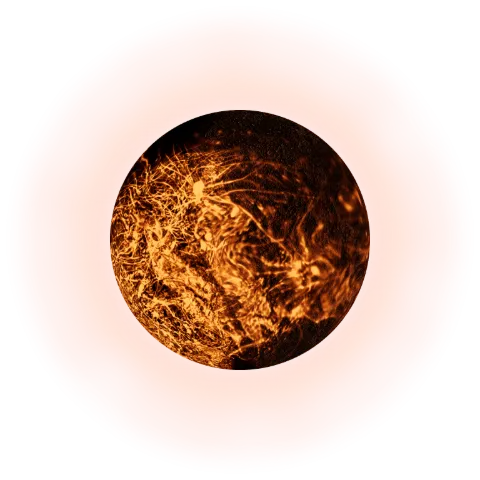
A giant planet so hot on its day side that iron boils into the air. Winds carry the vapour to the cooler night side, where it may condense and fall as iron rain.
- Radius
- 1.83 × Jupiter
- Temperature
- 2,160 K (1,887 °C)
- From Earth
- 634 light‑years
Iron Rain World at a glance
- Status
- Confirmed planet
- Radius
- 1.83 × Jupiter
- Mass
- 0.919 × Jupiter
- Year length
- 1.81 days
- Temperature
- 2,160 K (1,887 °C)
- Host star
- WASP-76, a white-yellow star
- From Earth
- 634 light-years
- Discovered
- 2013 · Transit
- Data
- Published studies
Facts
- It is locked with one side always facing its star, and the day side passes 2,000 °C.
- In 2020 the ESPRESSO instrument found iron vapour on the evening edge of the planet but not the morning edge, a sign that the iron condenses during the night.
- Later studies also found calcium, barium and other metals in its atmosphere.
- It orbits about 30 times closer to its star than Earth is to the Sun.
- It is about 1.8 times as wide as Jupiter, but a little lighter.
History and research
The WASP survey found it, and it was announced in 2016. It is about 640 light-years away in Pisces.
In 2024 Olivier Demangeon’s team, using ESA’s CHEOPS satellite, reported a flash of light from one edge of it. It may be a glory, the ring of colours seen around a plane’s shadow on a cloud. If confirmed, it would be the first outside the Solar System.
Sources: Wikipedia: WASP-76b. Checked 27 October 2026.
How big is Iron Rain World?
Iron Rain World is 261,211 km across: 1.87 times as wide as Jupiter.
Questions about Iron Rain World
How far away is WASP-76 b?
634 light-years from Earth. Even at the speed of light, the trip would take 634 years.
How big is WASP-76 b?
Its radius is 1.83 times Jupiter’s, about 20.5 times as wide as Earth.
How long is a year on WASP-76 b?
It goes once round its star in 1.81 days. How old would you be there? →
How hot is WASP-76 b?
About 2,160 K (1,887 °C).
What would I weigh on WASP-76 b?
At the cloud tops (there is no ground to stand on), gravity is 6.82 m/s², 69% of Earth’s. Scales that read 50 kg on Earth would read about 34.7 kg on WASP-76 b. Work out your own weight there →
When was WASP-76 b discovered?
In 2013, by the transit method: the slight dip in its star’s light each time the planet passes in front of it.
More Exoplanets
All planetsHot PlanetsMirror PlanetLTT 9779 b · Ultra-hot NeptuneRadius4.72 × EarthTemperature1,978 K (1,705 °C) Hot PlanetsLava-Ocean World55 Cancri e (Janssen) · Super-Earth lava worldRadius1.88 × EarthTemperature1,958 K (1,685 °C) Hot PlanetsNaked CoreTOI-849 b · Exposed planetary coreRadius3.64 × EarthTemperature1,932 K (1,659 °C) Hot PlanetsDarkest Planet KnownTrES-2b · Hot JupiterRadius1.36 × JupiterTemperature1,466 K (1,193 °C) Hot PlanetsFastest-Wind PlanetWASP-127b · Puffy Saturn-mass giantRadius1.31 × JupiterTemperature1,400 K (1,127 °C) Hot PlanetsBlue Glass-Rain PlanetHD 189733b · Hot JupiterRadius1.13 × JupiterTemperature1,209 K (936 °C) Hot PlanetsBocaprinsWASP-39 b · Hot SaturnRadius1.27 × JupiterTemperature1,170 K (897 °C) Hot PlanetsCracked Lava WorldGliese 876 d · Super-EarthRadius2.51 × EarthTemperature603 K (330 °C)