Hot Planets
Blue Glass-Rain Planet
HD 189733b · Hot Jupiter
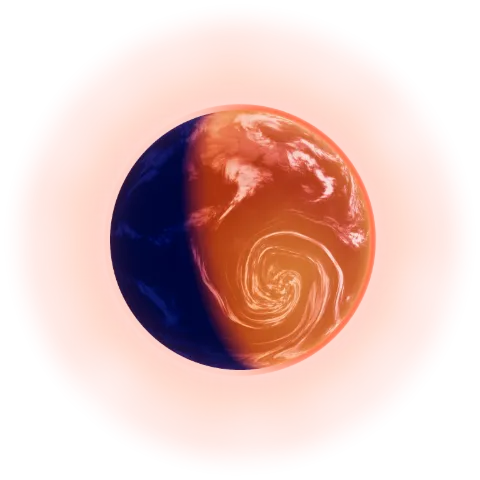
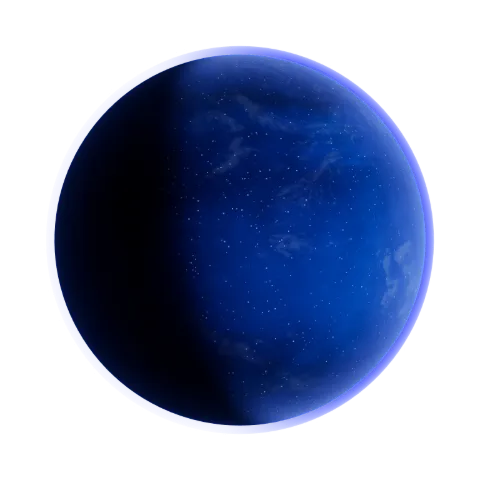
A deep cobalt-blue world, coloured by silicate particles in its air. Winds of about 8,700 km/h may whip them into glass that rains sideways, and JWST found hydrogen sulfide, so it would smell of rotten eggs.
- Radius
- 1.13 × Jupiter
- Temperature
- 1,209 K (936 °C)
- From Earth
- 64.5 light‑years
- Colour
- Deep blue, from silicate (glass) particles, not water
- Rain
- Molten glass, blown sideways by 8,700 km/h winds
- Smell
- Rotten eggs: JWST found hydrogen sulfide
- Day side
- About 930 °C
- Distance
- 64 light-years, one of the best-studied exoplanets
There is no ground to stand on here, so you hover on a small platform: no one could survive here, and the colours are educated guesses.
Blue Glass-Rain Planet at a glance
- Status
- Confirmed planet
- Radius
- 1.13 × Jupiter
- Mass
- 1.13 × Jupiter
- Year length
- 2.22 days
- Temperature
- 1,209 K (936 °C)
- Host star
- HD 189733 (K2 V)
- From Earth
- 64.5 light-years
- Discovered
- 2005 · Radial velocity
- Data
- NASA Exoplanet Archive
Facts
- From space it might look like a beautiful deep-blue marble, much like Earth. That is completely deceptive.
- The blue comes not from water but from silicates, the stuff glass is made of, which in the heat melt into drops of liquid glass.
- Winds of up to 8,700 km/h (5,400 mph) mean the molten glass rains sideways.
- JWST found hydrogen sulfide, the chemical that makes rotten eggs smell, so the whole world reeks.
- Its bright side reaches around 930 °C (1,700 °F).
History and research
François Bouchy’s team found it crossing its star in 2005, about 64 light-years away in Vulpecula, close in the sky to the Dumbbell Nebula. Because its star is close and bright, it became one of the most studied planets anywhere.
In 2007 Heather Knutson used the Spitzer telescope to make the first map of an exoplanet’s temperature, and found the hottest point blown downwind from noon. In 2013 Tom Evans’s team caught its light just before and after it slipped behind its star with Hubble and measured its colour: the first planet outside the Solar System whose colour was known.
Sources: Wikipedia: HD 189733 b. Checked 27 October 2026.
How big is Blue Glass-Rain Planet?
Blue Glass-Rain Planet is 161,390 km across: 1.15 times as wide as Jupiter.
Illustrations from NASA
Questions about Blue Glass-Rain Planet
How far away is HD 189733b?
64.5 light-years from Earth. Even at the speed of light, the trip would take 64.5 years.
How big is HD 189733b?
Its radius is 1.13 times Jupiter’s, about 12.7 times as wide as Earth.
How long is a year on HD 189733b?
It goes once round its star in 2.22 days. How old would you be there? →
How hot is HD 189733b?
About 1,209 K (936 °C).
When was HD 189733b discovered?
In 2005, by the radial-velocity method: the slight wobble the planet’s pull gives its star.
More Exoplanets
All planetsHot PlanetsBocaprinsWASP-39 b · Hot SaturnRadius1.27 × JupiterTemperature1,170 K (897 °C) Hot PlanetsCracked Lava WorldGliese 876 d · Super-EarthRadius2.51 × EarthTemperature603 K (330 °C) Hot PlanetsFire-and-Ice GiantHD 80606 b · Eccentric hot JupiterRadius1.03 × JupiterTemperature405 K (132 °C) Cold PlanetsFrozen Far WorldOGLE-2005-BLG-390Lb · Cold super-EarthRadius2.21 × EarthTemperature50 K (-223 °C) Cold PlanetsFamily PortraitHR 8799 b · Young gas giantTemperature900 K (627 °C)From Earth133 light‑years Cold PlanetsSuper SaturnJ1407b · Ringed companionFrom Earth434 light‑years Cold PlanetsMethuselahPSR B1620-26 b · Ancient giant planetRadius1.19 × JupiterFrom Earth5,600 light‑years Strange PlanetsThree-Sun WorldHD 188753 Ab · Hot Jupiter (unconfirmed)From Earth150 light‑yearsYear length3.35 days