32 worlds
Solar System
One star, eight planets and a handful of the moons that circle them, from scorched Mercury to the winds of Neptune, plus the one place in space people live today.
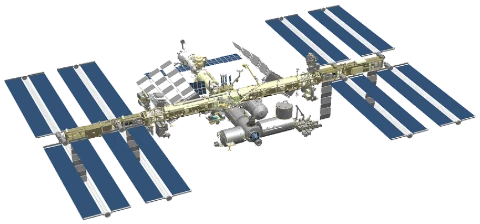
The SunSunG-type main-sequence starRadius695,700 kmOrbital period≈ 230 million years (galactic) PlanetsMercuryTerrestrial planetRadius2,440 kmOrbital period87.97 days PlanetsVenusTerrestrial planetRadius6,052 kmOrbital period224.70 days PlanetsEarthTerrestrial planetRadius6,371 kmOrbital period365.26 days MoonsMoonNatural satelliteRadius1,737 kmOrbital period27.32 days around Earth SpacecraftISSInternational Space StationSize109 m across · about a football pitchAbove Earth≈ 420 km PlanetsMarsTerrestrial planetRadius3,390 kmOrbital period686.98 days MoonsPhobosMoon of MarsRadius11 kmSize27 × 22 × 18 km Comets and asteroidsBennuNear-Earth asteroidRadius0 kmSizeabout 490 m across Comets and asteroidsVestaAsteroid · Asteroid beltRadius263 kmOrbital period3.63 years Dwarf planetsCeresDwarf planet · Asteroid beltRadius470 kmOrbital period4.60 years PlanetsJupiterGas giantRadius69,911 kmOrbital period11.86 years MoonsIoGalilean moonRadius1,822 kmOrbital period1.77 days around Jupiter MoonsEuropaGalilean moonRadius1,561 kmOrbital period3.55 days around Jupiter MoonsGanymedeGalilean moonRadius2,634 kmOrbital period7.16 days around Jupiter MoonsCallistoGalilean moonRadius2,410 kmOrbital period16.69 days around Jupiter PlanetsSaturnGas giantRadius58,232 kmOrbital period29.46 years MoonsTitanMoon of SaturnRadius2,575 kmOrbital period15.95 days around Saturn MoonsEnceladusMoon of SaturnRadius252 kmOrbital period1.37 days around Saturn MoonsMimasMoon of SaturnRadius198 kmOrbital period0.94 days around Saturn MoonsIapetusMoon of SaturnRadius735 kmOrbital period79.32 days around Saturn PlanetsUranusIce giantRadius25,362 kmOrbital period84.01 years MoonsMirandaMoon of UranusRadius236 kmOrbital period1.41 days around Uranus PlanetsNeptuneIce giantRadius24,622 kmOrbital period164.79 years MoonsTritonMoon of NeptuneRadius1,353 kmOrbital period5.88 days around Neptune Comets and asteroidsHalley’s CometPeriodic comet · 1P/HalleyRadius6 kmOrbital period75.29 years Dwarf planetsPlutoDwarf planet · Kuiper beltRadius1,188 kmOrbital period247.94 years MoonsCharonMoon of PlutoRadius606 kmOrbital period6.39 days around Pluto Dwarf planetsHaumeaDwarf planet · Kuiper beltRadius780 kmSizeabout 2,100 km long, half as wide Dwarf planetsMakemakeDwarf planet · Kuiper beltRadius715 kmOrbital period307.62 years Comets and asteroidsArrokothKuiper belt object · contact binaryRadius9 kmSizeabout 36 km long Dwarf planetsErisDwarf planet · Scattered discRadius1,163 kmOrbital period559.89 years
Our corner of space
How it formed
About 4.6 billion years ago a cloud of gas and dust collapsed under its own gravity. Most of it fell to the centre and became the Sun; the rest flattened into a spinning disk, where dust stuck together into pebbles, then boulders and, over millions of years, planets. That is why the planets all orbit in nearly the same plane, and in the same direction.
Rocky worlds and giants
Close to the young Sun it was too hot for ice, so only rock and metal could gather, and Mercury, Venus, Earth and Mars stayed small. Farther out, beyond the “frost line”, ice was plentiful, and Jupiter and Saturn grew big enough to pull in vast amounts of hydrogen and helium. Uranus and Neptune, farther still, are made mostly of ices of water, methane and ammonia.
Moons, oceans and life
Most moons are frozen and airless, but a few are anything but dull. Europa and Ganymede hide oceans under their ice, Io is covered in volcanoes, and Titan has rain, rivers and seas of liquid methane. Europa Clipper and Juice are on their way to Jupiter’s moons, and Dragonfly will follow to Titan, to find out whether any of them could support life.