Hot Planets
Fastest-Wind Planet
WASP-127b · Puffy Saturn-mass giant
Home to the fastest planetary winds ever measured: a supersonic equatorial jet of about 33,000 km/h (9 km/s), found by ESO in 2025. Neptune, the Solar System’s record holder, manages 1,800 km/h.
- Radius
- 1.31 × Jupiter
- Temperature
- 1,400 K (1,127 °C)
- From Earth
- 520 light‑years
- Wind
- A jet stream at about 33,000 km/h, the fastest ever measured
- Compared
- Neptune’s fastest winds, the Solar System’s record: 1,800 km/h
- Temperature
- About 1,100 °C, cooler at the poles
- Day and night
- Morning and evening sides differ in temperature
- One year
- 4.2 days
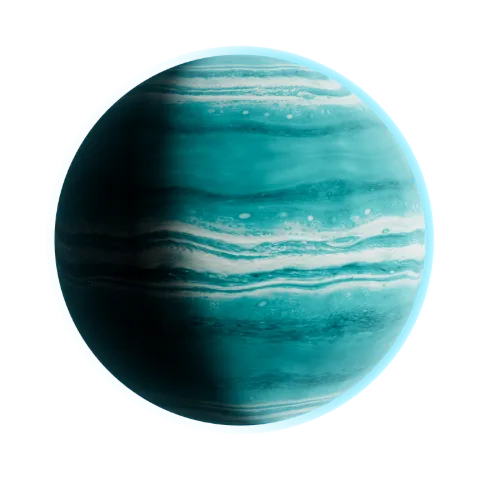
The real jet would cross Earth in under an hour; the clouds here are slowed right down so you can follow them. There is no ground to stand on here, so you hover on a small platform: no one could survive here, and the colours are educated guesses.
Fastest-Wind Planet at a glance
- Status
- Confirmed planet
- Radius
- 1.31 × Jupiter
- Mass
- 0.165 × Jupiter
- Year length
- 4.18 days
- Temperature
- 1,400 K (1,127 °C)
- Host star
- WASP-127 (G-type)
- From Earth
- 520 light-years
- Discovered
- 2016 · Transit
- Data
- NASA Exoplanet Archive
Facts
- Its winds scream around the equator at up to 33,000 km/h (20,500 mph): the fastest jet stream ever measured on a planet.
- That is fast enough to cross the Earth in well under an hour.
- Its year is just 4 days, and its air is around 1,100 °C (2,000 °F).
- The winds were found by watching starlight pass through its air: part of the gas was rushing towards us and part away, which only a supersonic jet stream explains.
- The jet races almost 6 times faster than the planet itself spins.
- Neptune’s winds, the Solar System’s fastest at about 1,800 km/h (1,100 mph), would count as a gentle breeze here.
- Its weather isn’t uniform: the poles are cooler, and the morning and evening sides differ in temperature.
History and research
The WASP-South survey found it in 2016, about 520 light-years away in Hydra. It has about a sixth of Jupiter’s mass but is larger than Jupiter, one of the least dense planets known.
In 2025 Lisa Nortmann’s team used the CRIRES+ instrument on the Very Large Telescope to measure its winds. They saw some of the gas moving towards us and some away, as it crossed the star.
Sources: Wikipedia: WASP-127b. Checked 27 October 2026.
How big is Fastest-Wind Planet?
Fastest-Wind Planet is 187,244 km across: 1.34 times as wide as Jupiter.
Questions about Fastest-Wind Planet
How far away is WASP-127b?
520 light-years from Earth. Even at the speed of light, the trip would take 520 years.
How big is WASP-127b?
Its radius is 1.31 times Jupiter’s, about 14.7 times as wide as Earth.
How long is a year on WASP-127b?
It goes once round its star in 4.18 days. How old would you be there? →
How hot is WASP-127b?
About 1,400 K (1,127 °C).
What would I weigh on WASP-127b?
At the cloud tops (there is no ground to stand on), gravity is 2.38 m/s², 24% of Earth’s. Scales that read 50 kg on Earth would read about 12.1 kg on WASP-127b. Work out your own weight there →
When was WASP-127b discovered?
In 2016, by the transit method: the slight dip in its star’s light each time the planet passes in front of it.
More Exoplanets
All planetsHot PlanetsBlue Glass-Rain PlanetHD 189733b · Hot JupiterRadius1.13 × JupiterTemperature1,209 K (936 °C) Hot PlanetsBocaprinsWASP-39 b · Hot SaturnRadius1.27 × JupiterTemperature1,170 K (897 °C) Hot PlanetsCracked Lava WorldGliese 876 d · Super-EarthRadius2.51 × EarthTemperature603 K (330 °C) Hot PlanetsFire-and-Ice GiantHD 80606 b · Eccentric hot JupiterRadius1.03 × JupiterTemperature405 K (132 °C) Cold PlanetsFrozen Far WorldOGLE-2005-BLG-390Lb · Cold super-EarthRadius2.21 × EarthTemperature50 K (-223 °C) Cold PlanetsFamily PortraitHR 8799 b · Young gas giantTemperature900 K (627 °C)From Earth133 light‑years Cold PlanetsSuper SaturnJ1407b · Ringed companionFrom Earth434 light‑years Cold PlanetsMethuselahPSR B1620-26 b · Ancient giant planetRadius1.19 × JupiterFrom Earth5,600 light‑years