Hot Planets
Mirror Planet
LTT 9779 b · Ultra-hot Neptune
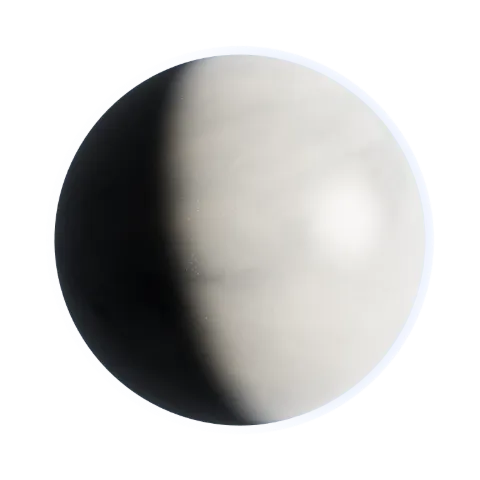
The shiniest exoplanet known, reflecting roughly 70–80% of its starlight, about as much as Venus. Metal-rich clouds of silicate droplets make it a mirror despite a 2,000 K atmosphere, in the “Neptune desert” where such planets shouldn’t survive.
- Radius
- 4.72 × Earth
- Temperature
- 1,978 K (1,705 °C)
- From Earth
- 262 light‑years
- Shine
- Reflects about 75% of its light, the most of any planet known
- Clouds
- Metal and glass (silicate) droplets
- Temperature
- Over 2,000 °C on the side facing the star
- One year
- 19 hours
- Mystery
- It lies in the “Neptune desert”, where planets its size get stripped bare
Its heavy, metal-rich air may be why it survives. The glinting motes stand for droplets of metal and glass. There is no ground to stand on here, so you hover on a small platform: no one could survive here, and the colours are educated guesses.
Mirror Planet at a glance
- Status
- Confirmed planet
- Radius
- 4.72 × Earth
- Mass
- 29.3 × Earth
- Year length
- 19 hours
- Temperature
- 1,978 K (1,705 °C)
- Reflectivity
- Geometric albedo ≈ 0.7–0.8
- Host star
- LTT 9779 (G7 V)
- From Earth
- 262 light-years
- Discovered
- 2020 · Transit
- Data
- NASA Exoplanet Archive
Facts
- Officially named Cuancoá, it is also known as the mirror planet.
- Its clouds are made of metal and glass, so it bounces back roughly three-quarters (about 73%) of its light: the most reflective planet ever found.
- Its metal-heavy atmosphere acts like a metallic blanket, which is why telescopes struggle to see deeper inside it.
- It is an “ultra-hot Neptune”: so close to its star that a year lasts under 24 hours, with the star-facing side above 2,000 °C (3,600 °F).
- It shouldn’t exist. It lies in the “Neptunian desert”, where radiation usually strips planets its size bare; its heavy, metal-rich air may be why it doesn’t puff away.
History and research
James Jenkins’s team announced it in 2020 from some of TESS’s first data. Its star is about 260 light-years away. Its mass was measured with the HARPS spectrograph in Chile.
In 2023 ESA’s CHEOPS satellite measured how much light it reflects by watching it slip behind its star. The drop in light was larger than its heat alone could explain, which showed how bright it is.
Sources: Wikipedia: LTT 9779 b. Checked 27 October 2026.
How big is Mirror Planet?
Mirror Planet is 60,142 km across: 4.72 times as wide as Earth.
Questions about Mirror Planet
How far away is LTT 9779 b?
262 light-years from Earth. Even at the speed of light, the trip would take 262 years.
How big is LTT 9779 b?
Its radius is 4.72 times Earth’s, about 4.7 times as wide as Earth.
How long is a year on LTT 9779 b?
It goes once round its star in 19 hours. How old would you be there? →
How hot is LTT 9779 b?
About 1,978 K (1,705 °C).
What would I weigh on LTT 9779 b?
At the cloud tops (there is no ground to stand on), gravity is 12.9 m/s², 1.32 times Earth’s. Scales that read 50 kg on Earth would read about 65.8 kg on LTT 9779 b. Work out your own weight there →
When was LTT 9779 b discovered?
In 2020, by the transit method: the slight dip in its star’s light each time the planet passes in front of it.
More Exoplanets
All planetsHot PlanetsLava-Ocean World55 Cancri e (Janssen) · Super-Earth lava worldRadius1.88 × EarthTemperature1,958 K (1,685 °C) Hot PlanetsNaked CoreTOI-849 b · Exposed planetary coreRadius3.64 × EarthTemperature1,932 K (1,659 °C) Hot PlanetsDarkest Planet KnownTrES-2b · Hot JupiterRadius1.36 × JupiterTemperature1,466 K (1,193 °C) Hot PlanetsFastest-Wind PlanetWASP-127b · Puffy Saturn-mass giantRadius1.31 × JupiterTemperature1,400 K (1,127 °C) Hot PlanetsBlue Glass-Rain PlanetHD 189733b · Hot JupiterRadius1.13 × JupiterTemperature1,209 K (936 °C) Hot PlanetsBocaprinsWASP-39 b · Hot SaturnRadius1.27 × JupiterTemperature1,170 K (897 °C) Hot PlanetsCracked Lava WorldGliese 876 d · Super-EarthRadius2.51 × EarthTemperature603 K (330 °C) Hot PlanetsFire-and-Ice GiantHD 80606 b · Eccentric hot JupiterRadius1.03 × JupiterTemperature405 K (132 °C)