Hot Planets
Cracked Lava World
Gliese 876 d · Super-Earth
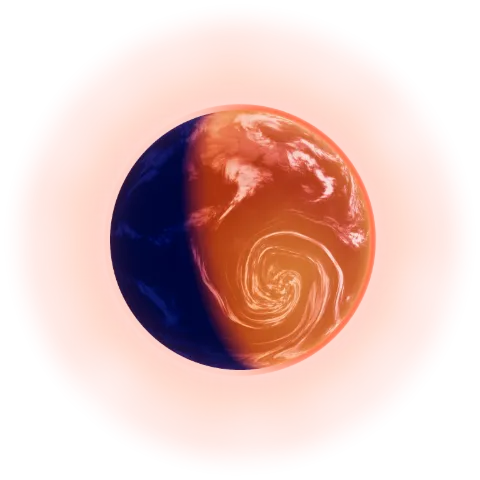
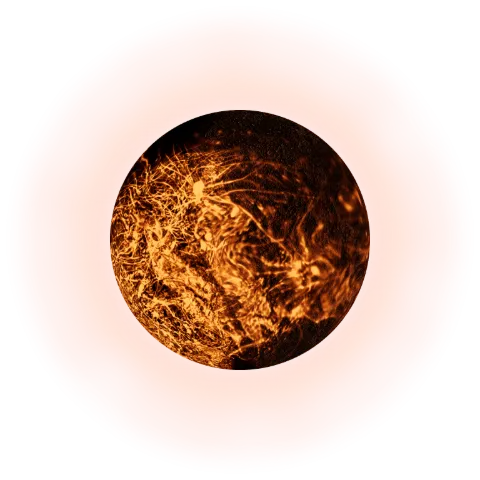
One of the first super-Earths ever found (2005), circling its red dwarf in under two days. Baked by its star and squeezed by tides on its slightly oval orbit, its surface may be partly molten: a cracked crust over glowing lava.
- Radius
- 2.51 × Earth
- Temperature
- 603 K (330 °C)
- From Earth
- 15.2 light‑years
- Ground
- Never still: kneaded by its star and its giant neighbours like a rubber ball
- Inside
- Kept molten by that squeezing, feeding volcanoes and lava
- Sky
- Dark red, under a red dwarf sun
- Temperature
- About 330 °C
- One year
- Under 2 days
One of the first super-Earths found (2005). Its surface has never been seen: the volcanoes, lava and cracked crust show what the tidal heating may do.
Cracked Lava World at a glance
- Status
- Confirmed planet
- Radius
- 2.51 × Earth
- Mass
- 6.83 × Earth
- Year length
- 1.94 days
- Orbit eccentricity
- 0.21
- Temperature
- 603 K (330 °C)
- Host star
- Gliese 876 (M2.5 V red dwarf)
- From Earth
- 15.2 light-years
- Discovered
- 2005 · Radial velocity
- Data
- NASA Exoplanet Archive
Facts
- Often called the Endless Volcano: stand on it, and the ground would never stop shaking.
- A rocky planet larger than Earth, circling very close to a small star.
- It is trapped in a pulling contest: its sun pulls it one way while giant gas planets in the same system yank it back.
- That push and pull stretches and squishes the whole planet like a rubber ball, keeping its inside melted.
- The result: non-stop, massive earthquakes, and giant volcanoes erupting all over, flooding the ground with lava under a dark red sky.
History and research
Gliese 876, a red dwarf 15 light-years away in Aquarius, was the first red dwarf found with a planet: two teams announced a giant there in 1998. A second giant followed in 2001. In 2005 Eugenio Rivera’s team found a third signal, a planet of about seven Earth masses, one of the first super-Earths known.
A fourth planet, found in 2010, completed a rare pattern. Three of the planets are locked in step, completing one, two and four orbits in the same time, as Jupiter’s moons Io, Europa and Ganymede do. It was the first such chain found around another star.
Sources: Wikipedia: Gliese 876 d, Wikipedia: Gliese 876. Checked 27 October 2026.
How big is Cracked Lava World?
Cracked Lava World is 31,982 km across: 2.51 times as wide as Earth.
Questions about Cracked Lava World
How far away is Gliese 876 d?
15.2 light-years from Earth. Even at the speed of light, the trip would take 15.2 years.
How big is Gliese 876 d?
Its radius is 2.51 times Earth’s, about 2.5 times as wide as Earth.
How long is a year on Gliese 876 d?
It goes once round its star in 1.94 days. How old would you be there? →
How hot is Gliese 876 d?
About 603 K (330 °C).
When was Gliese 876 d discovered?
In 2005, by the radial-velocity method: the slight wobble the planet’s pull gives its star.
More Exoplanets
All planetsHot PlanetsFire-and-Ice GiantHD 80606 b · Eccentric hot JupiterRadius1.03 × JupiterTemperature405 K (132 °C) Cold PlanetsFrozen Far WorldOGLE-2005-BLG-390Lb · Cold super-EarthRadius2.21 × EarthTemperature50 K (-223 °C) Cold PlanetsFamily PortraitHR 8799 b · Young gas giantTemperature900 K (627 °C)From Earth133 light‑years Cold PlanetsSuper SaturnJ1407b · Ringed companionFrom Earth434 light‑years Cold PlanetsMethuselahPSR B1620-26 b · Ancient giant planetRadius1.19 × JupiterFrom Earth5,600 light‑years Strange PlanetsThree-Sun WorldHD 188753 Ab · Hot Jupiter (unconfirmed)From Earth150 light‑yearsYear length3.35 days Strange PlanetsDead-Star PlanetsPSR B1257+12 · Planets orbiting a dead starFrom Earth1,957 light‑years Strange PlanetsBackwards PlanetWASP-17b · Puffy hot JupiterRadius1.87 × JupiterTemperature1,755 K (1,482 °C)