Hot Planets
Darkest Planet Known
TrES-2b · Hot Jupiter
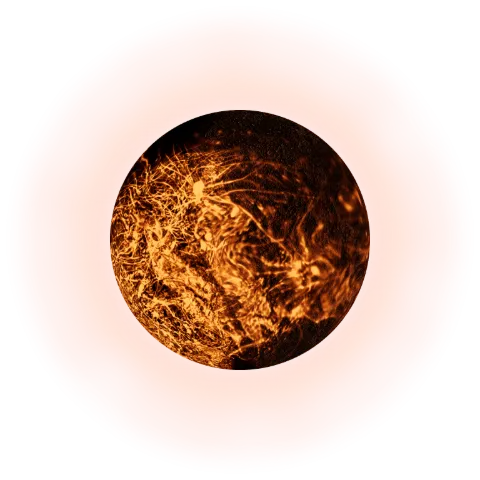
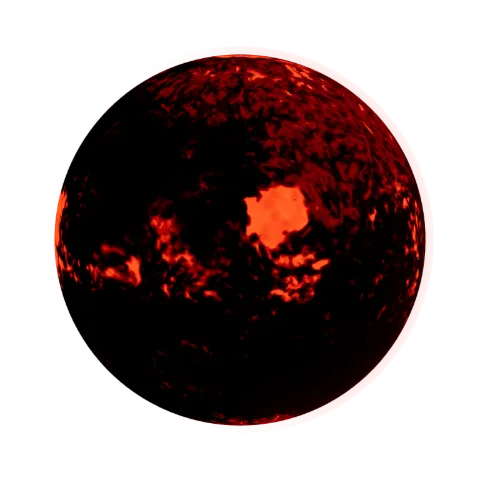
The darkest exoplanet known: it reflects less than 1% of the light that hits it, darker than coal. Gases such as vaporised sodium and potassium may absorb the light, leaving only a faint red glow from its own heat.
- Radius
- 1.36 × Jupiter
- Temperature
- 1,466 K (1,193 °C)
- From Earth
- 702 light‑years
- Darkness
- Reflects under 1% of light: darker than coal
- Glow
- A faint red, like the coil of an electric stove
- Temperature
- Around 1,000–1,200 °C, too hot for reflective clouds
- Air
- Likely vaporised sodium, potassium and titanium oxide, which absorb light
- One year
- 2.5 days
Why it is quite this dark is still a mystery. The red glow is its own heat. There is no ground to stand on here, so you hover on a small platform: no one could survive here, and the colours are educated guesses.
Darkest Planet Known at a glance
- Status
- Confirmed planet
- Radius
- 1.36 × Jupiter
- Mass
- 1.49 × Jupiter
- Year length
- 2.47 days
- Temperature
- 1,466 K (1,193 °C)
- Host star
- TrES-2 (G0 V)
- From Earth
- 702 light-years
- Discovered
- 2006 · Transit
- Data
- NASA Exoplanet Archive
Facts
- A Jupiter-sized gas giant that looks nothing like the planets in our Solar System.
- In 2011 it was named the darkest exoplanet ever found: it reflects less than 1% of the light that hits it, darker than coal or black acrylic paint.
- Nobody is fully sure why. It is over 975 °C (1,790 °F), too hot for reflective ammonia clouds, so its air may be full of light-absorbing vaporised sodium, potassium or titanium oxide.
- Even those can’t fully explain how black it is; the true cause is still a mystery.
- Up close it wouldn’t be a perfectly black sphere: it glows a faint, dim red, like a burning ember or the coil of an electric stove floating in the void.
History and research
It was found in 2006 by TrES, the Trans-Atlantic Exoplanet Survey, a set of small telescopes in the United States and the Canary Islands. It lies about 750 light-years away in Draco.
By chance it falls in the field Kepler stared at. In 2011 David Kipping and David Spiegel added up more than 50 of its orbits in Kepler’s data and found how little its light changes as it goes round. That tiny change gave its reflectivity.
Sources: Wikipedia: TrES-2b. Checked 27 October 2026.
How big is Darkest Planet Known?
Darkest Planet Known is 194,239 km across: 1.39 times as wide as Jupiter.
Questions about Darkest Planet Known
How far away is TrES-2b?
702 light-years from Earth. Even at the speed of light, the trip would take 702 years.
How big is TrES-2b?
Its radius is 1.36 times Jupiter’s, about 15.2 times as wide as Earth.
How long is a year on TrES-2b?
It goes once round its star in 2.47 days. How old would you be there? →
How hot is TrES-2b?
About 1,466 K (1,193 °C).
What would I weigh on TrES-2b?
At the cloud tops (there is no ground to stand on), gravity is 20 m/s², 2.04 times Earth’s. Scales that read 50 kg on Earth would read about 102 kg on TrES-2b. Work out your own weight there →
When was TrES-2b discovered?
In 2006, by the transit method: the slight dip in its star’s light each time the planet passes in front of it.
More Exoplanets
All planetsHot PlanetsFastest-Wind PlanetWASP-127b · Puffy Saturn-mass giantRadius1.31 × JupiterTemperature1,400 K (1,127 °C) Hot PlanetsBlue Glass-Rain PlanetHD 189733b · Hot JupiterRadius1.13 × JupiterTemperature1,209 K (936 °C) Hot PlanetsBocaprinsWASP-39 b · Hot SaturnRadius1.27 × JupiterTemperature1,170 K (897 °C) Hot PlanetsCracked Lava WorldGliese 876 d · Super-EarthRadius2.51 × EarthTemperature603 K (330 °C) Hot PlanetsFire-and-Ice GiantHD 80606 b · Eccentric hot JupiterRadius1.03 × JupiterTemperature405 K (132 °C) Cold PlanetsFrozen Far WorldOGLE-2005-BLG-390Lb · Cold super-EarthRadius2.21 × EarthTemperature50 K (-223 °C) Cold PlanetsFamily PortraitHR 8799 b · Young gas giantTemperature900 K (627 °C)From Earth133 light‑years Cold PlanetsSuper SaturnJ1407b · Ringed companionFrom Earth434 light‑years