Hot Planets
Lava-Ocean World
55 Cancri e (Janssen) · Super-Earth lava world
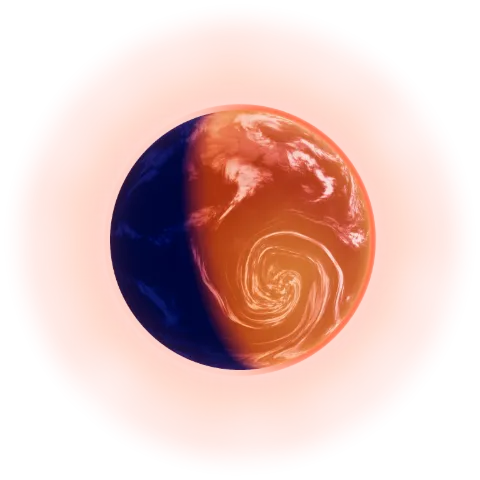
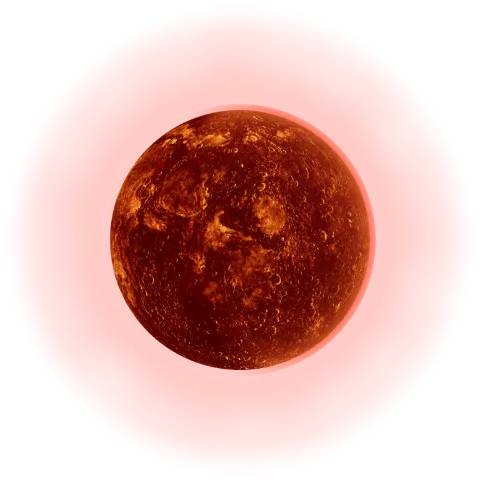
So close to its star that a year lasts 18 hours and its dayside is likely a magma ocean. JWST found hints of an atmosphere of carbon monoxide or dioxide, probably bubbling out of the lava, though that is still debated.
- Radius
- 1.88 × Earth
- Temperature
- 1,958 K (1,685 °C)
- From Earth
- 41.0 light‑years
- Surface
- A global ocean of molten rock
- Day side
- Over 2,200 °C
- Air
- Thick gas bubbling out of the lava (JWST, still debated)
- Night side
- Rock vapour may condense and fall as stone
- One year
- Under 18 hours
Once thought to be a “diamond planet”; that idea has faded. No one could survive here; you hover on a small platform.
Lava-Ocean World at a glance
- Status
- Confirmed planet
- Radius
- 1.88 × Earth
- Mass
- 7.99 × Earth
- Year length
- 17.7 hours
- Temperature
- 1,958 K (1,685 °C)
- Host star
- 55 Cancri A (G8 V)
- From Earth
- 41.0 light-years
- Discovered
- 2004 · Radial velocity
- Data
- NASA Exoplanet Archive
Facts
- Also called Janssen: a “super-Earth”, rocky like our planet but much larger and heavier. That is roughly where the similarities end.
- It orbits so close to its star that a year lasts under 18 hours, and one side always faces the star.
- That day side reaches over 2,200 °C (4,000 °F), so hot the ground is completely melted into a global ocean of boiling rock.
- For a long time scientists thought its interior might be largely solid diamond.
- JWST now suggests the bubbling magma releases a thick, heavy atmosphere of gas covering the world.
- Melted rock may even evaporate into the sky, then rain down as stone when winds carry it to the cooler night side: a real-life lava level from a video game.
History and research
A team led by Barbara McArthur found it in 2004 from its pull on its star, but got its year wrong: the data seemed to say 2.8 days. In 2011 Rebekah Dawson and Daniel Fabrycky showed that the signal was an alias, a false echo caused by observing only at night, and that the real year was under 18 hours.
With the right period known, the MOST and Spitzer space telescopes caught it crossing its star later that year. In 2016 a Spitzer study found that the heat coming from it changed from one observation to the next, which could mean volcanoes or a shifting atmosphere. Its star is one of the few with five known planets, and can be seen with the naked eye under a dark sky.
Sources: Wikipedia: 55 Cancri e, Wikipedia: 55 Cancri. Checked 27 October 2026.
How big is Lava-Ocean World?
Lava-Ocean World is 23,891 km across: 1.88 times as wide as Earth.
Illustrations from NASA
Questions about Lava-Ocean World
How far away is 55 Cancri e?
41.0 light-years from Earth. Even at the speed of light, the trip would take 41.0 years.
How big is 55 Cancri e?
Its radius is 1.88 times Earth’s, about 1.9 times as wide as Earth.
How long is a year on 55 Cancri e?
It goes once round its star in 17.7 hours. How old would you be there? →
How hot is 55 Cancri e?
About 1,958 K (1,685 °C).
What would I weigh on 55 Cancri e?
Gravity at the surface is 22.3 m/s², 2.27 times Earth’s. Scales that read 50 kg on Earth would read about 114 kg on 55 Cancri e. Work out your own weight there →
When was 55 Cancri e discovered?
In 2004, by the radial-velocity method: the slight wobble the planet’s pull gives its star.
More Exoplanets
All planetsHot PlanetsNaked CoreTOI-849 b · Exposed planetary coreRadius3.64 × EarthTemperature1,932 K (1,659 °C) Hot PlanetsDarkest Planet KnownTrES-2b · Hot JupiterRadius1.36 × JupiterTemperature1,466 K (1,193 °C) Hot PlanetsFastest-Wind PlanetWASP-127b · Puffy Saturn-mass giantRadius1.31 × JupiterTemperature1,400 K (1,127 °C) Hot PlanetsBlue Glass-Rain PlanetHD 189733b · Hot JupiterRadius1.13 × JupiterTemperature1,209 K (936 °C) Hot PlanetsBocaprinsWASP-39 b · Hot SaturnRadius1.27 × JupiterTemperature1,170 K (897 °C) Hot PlanetsCracked Lava WorldGliese 876 d · Super-EarthRadius2.51 × EarthTemperature603 K (330 °C) Hot PlanetsFire-and-Ice GiantHD 80606 b · Eccentric hot JupiterRadius1.03 × JupiterTemperature405 K (132 °C) Cold PlanetsFrozen Far WorldOGLE-2005-BLG-390Lb · Cold super-EarthRadius2.21 × EarthTemperature50 K (-223 °C)