Hot Planets
Gem-Rain Planet
WASP-121b · Ultra-hot Jupiter
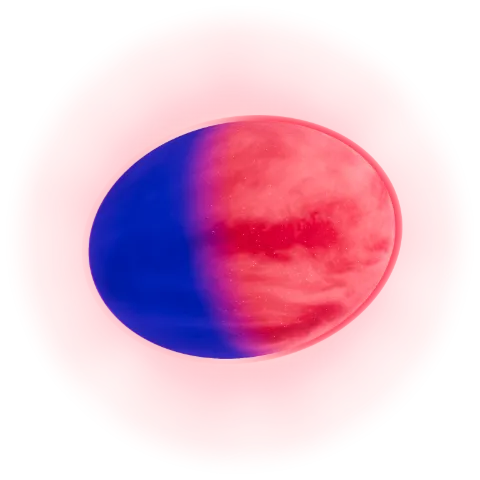
Stretched into an egg shape by its star’s tides, with a dayside hot enough to vaporise metals. JWST found clouds of titanium-bearing minerals, and metals are thought to condense and rain out on the night side, the source of headlines about rains of liquid gems.
- Radius
- 1.74 × Jupiter
- Temperature
- 2,409 K (2,136 °C)
- From Earth
- 880 light‑years
- Rain
- Droplets of corundum, the stuff of rubies and sapphires, and iron
- Winds
- Tens of thousands of km/h, carrying metal vapour from the day side
- Glowing water
- Water high in its sky glows with heat, in infrared
- Day side
- Over 2,000 °C
- One year
- 30 hours
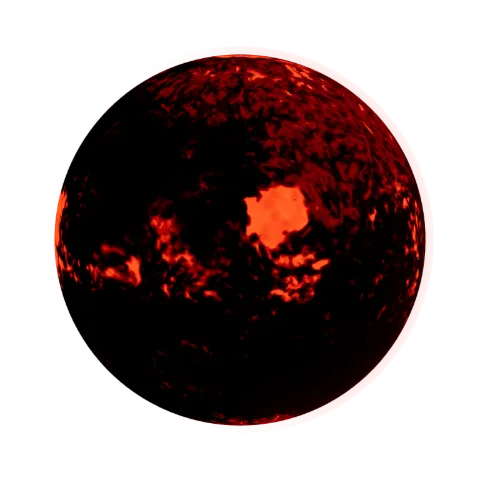
The red and blue glints stand for the ruby- and sapphire-like droplets. There is no ground to stand on here, so you hover on a small platform: no one could survive here, and the colours are educated guesses.
Gem-Rain Planet at a glance
- Status
- Confirmed planet
- Radius
- 1.74 × Jupiter
- Mass
- 1.17 × Jupiter
- Year length
- 1.27 days
- Temperature
- 2,409 K (2,136 °C)
- Host star
- WASP-121 (F6 V)
- From Earth
- 880 light-years
- Discovered
- 2016 · Transit
- Data
- NASA Exoplanet Archive
Facts
- A gas giant slightly larger than Jupiter, trapped in a nightmarish situation.
- The huge temperature difference between its hot and cold sides drives violent winds of tens of thousands of km/h.
- Those winds scoop up metal vapour from the day side, including iron and the very materials that make rubies and sapphires, and blow it to the night side.
- There it cools into thick clouds, so in the pitch-black night, chaotic storms literally rain droplets of liquid rubies and sapphires.
- High in its sky the water glows: heated so much that it gives off its own infrared light, like fireworks to a space telescope.
History and research
Laetitia Delrez’s team found it in 2015 with WASP-South, about 880 light-years away in Puppis. Its official name is Tylos, the ancient Greek name for Bahrain.
In 2025 Julia Seidel’s team used all four of the VLT’s main telescopes at once to map its weather in three dimensions. They found layered winds, including a jet stream of iron and other metals racing around its middle.
Sources: Wikipedia: WASP-121b. Checked 27 October 2026.
How big is Gem-Rain Planet?
Gem-Rain Planet is 248,800 km across: 1.78 times as wide as Jupiter.
Illustrations from NASA
Questions about Gem-Rain Planet
How far away is WASP-121b?
880 light-years from Earth. Even at the speed of light, the trip would take 880 years.
How big is WASP-121b?
Its radius is 1.74 times Jupiter’s, about 19.5 times as wide as Earth.
How long is a year on WASP-121b?
It goes once round its star in 1.27 days. How old would you be there? →
How hot is WASP-121b?
About 2,409 K (2,136 °C).
What would I weigh on WASP-121b?
At the cloud tops (there is no ground to stand on), gravity is 9.57 m/s², 98% of Earth’s. Scales that read 50 kg on Earth would read about 48.8 kg on WASP-121b. Work out your own weight there →
When was WASP-121b discovered?
In 2016, by the transit method: the slight dip in its star’s light each time the planet passes in front of it.
More Exoplanets
All planetsHot PlanetsIron Rain WorldWASP-76 b · Ultra-hot JupiterRadius1.83 × JupiterTemperature2,160 K (1,887 °C) Hot PlanetsMirror PlanetLTT 9779 b · Ultra-hot NeptuneRadius4.72 × EarthTemperature1,978 K (1,705 °C) Hot PlanetsLava-Ocean World55 Cancri e (Janssen) · Super-Earth lava worldRadius1.88 × EarthTemperature1,958 K (1,685 °C) Hot PlanetsNaked CoreTOI-849 b · Exposed planetary coreRadius3.64 × EarthTemperature1,932 K (1,659 °C) Hot PlanetsDarkest Planet KnownTrES-2b · Hot JupiterRadius1.36 × JupiterTemperature1,466 K (1,193 °C) Hot PlanetsFastest-Wind PlanetWASP-127b · Puffy Saturn-mass giantRadius1.31 × JupiterTemperature1,400 K (1,127 °C) Hot PlanetsBlue Glass-Rain PlanetHD 189733b · Hot JupiterRadius1.13 × JupiterTemperature1,209 K (936 °C) Hot PlanetsBocaprinsWASP-39 b · Hot SaturnRadius1.27 × JupiterTemperature1,170 K (897 °C)