Hot Planets
Pulsing-Star Planet
WASP-33b · Ultra-hot Jupiter
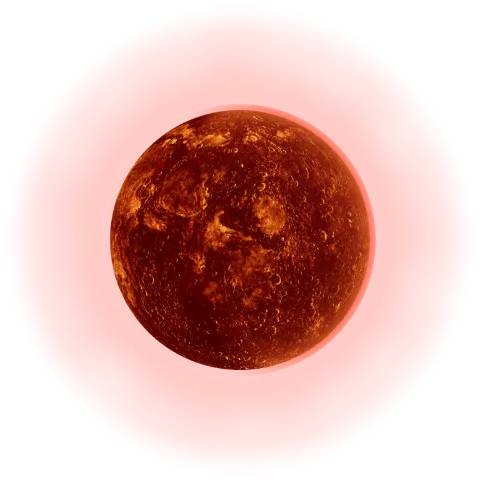
It orbits, backwards, a star whose surface throbs in and out in pulsations. The planet was the first found with a stratosphere: titanium oxide high in its sky soaks up starlight and heats the upper air, much as ozone does on Earth.

- Radius
- 1.59 × Jupiter
- Temperature
- 2,782 K (2,509 °C)
- From Earth
- 398 light‑years
- Its star
- Pulsates: swells and shrinks, its light rising and falling within hours
- Upside-down air
- Gets hotter the higher you go, a temperature inversion
- Why
- Titanium oxide high up soaks up starlight, as ozone does on Earth
- Day side
- About 3,000 °C
- Orbit
- Backwards, against its star’s spin
The star’s pulsing is sped up and exaggerated so you can see it. There is no ground to stand on here, so you hover on a small platform: no one could survive here, and the colours are educated guesses.
Pulsing-Star Planet at a glance
- Status
- Confirmed planet
- Radius
- 1.59 × Jupiter
- Mass
- 2.09 × Jupiter
- Year length
- 1.22 days
- Temperature
- 2,782 K (2,509 °C)
- Host star
- WASP-33 (pulsating A-type star)
- From Earth
- 398 light-years
- Discovered
- 2010 · Transit
- Data
- NASA Exoplanet Archive
Facts
- Its star pulses like a heart, physically swelling up and shrinking down, so its heat and brightness change within a few hours.
- The planet, trapped extremely close, is blasted with heat and then slightly less heat, over and over, making its sky messy and unstable.
- It has a temperature inversion: instead of cooling with height, its air gets hotter the higher you go.
- Some accounts put the top of its sky above 5,500 °C (10,000 °F); measurements of its day side give around 3,000 °C.
History and research
Andrew Collier Cameron’s team found it in 2010 with SuperWASP. Its star spins so fast that the usual way to weigh a planet failed, so they confirmed it by watching its shadow move across the star’s spinning surface.
The star is about 380 light-years away in Andromeda. In 2017 Stevanus Nugroho’s team confirmed titanium oxide in its upper air with the Subaru telescope.
Sources: Wikipedia: WASP-33b. Checked 27 October 2026.
How big is Pulsing-Star Planet?
Pulsing-Star Planet is 227,521 km across: 1.63 times as wide as Jupiter.
Questions about Pulsing-Star Planet
How far away is WASP-33b?
398 light-years from Earth. Even at the speed of light, the trip would take 398 years.
How big is WASP-33b?
Its radius is 1.59 times Jupiter’s, about 17.9 times as wide as Earth.
How long is a year on WASP-33b?
It goes once round its star in 1.22 days. How old would you be there? →
How hot is WASP-33b?
About 2,782 K (2,509 °C).
What would I weigh on WASP-33b?
At the cloud tops (there is no ground to stand on), gravity is 20.5 m/s², 2.09 times Earth’s. Scales that read 50 kg on Earth would read about 104 kg on WASP-33b. Work out your own weight there →
When was WASP-33b discovered?
In 2010, by the transit method: the slight dip in its star’s light each time the planet passes in front of it.
More Exoplanets
All planetsHot PlanetsDoomed PlanetWASP-12b · Ultra-hot JupiterRadius1.97 × JupiterTemperature2,601 K (2,328 °C) Hot PlanetsGem-Rain PlanetWASP-121b · Ultra-hot JupiterRadius1.74 × JupiterTemperature2,409 K (2,136 °C) Hot PlanetsIron Rain WorldWASP-76 b · Ultra-hot JupiterRadius1.83 × JupiterTemperature2,160 K (1,887 °C) Hot PlanetsMirror PlanetLTT 9779 b · Ultra-hot NeptuneRadius4.72 × EarthTemperature1,978 K (1,705 °C) Hot PlanetsLava-Ocean World55 Cancri e (Janssen) · Super-Earth lava worldRadius1.88 × EarthTemperature1,958 K (1,685 °C) Hot PlanetsNaked CoreTOI-849 b · Exposed planetary coreRadius3.64 × EarthTemperature1,932 K (1,659 °C) Hot PlanetsDarkest Planet KnownTrES-2b · Hot JupiterRadius1.36 × JupiterTemperature1,466 K (1,193 °C) Hot PlanetsFastest-Wind PlanetWASP-127b · Puffy Saturn-mass giantRadius1.31 × JupiterTemperature1,400 K (1,127 °C)