Hot Planets
Hottest Planet
KELT-9b · Ultra-hot Jupiter
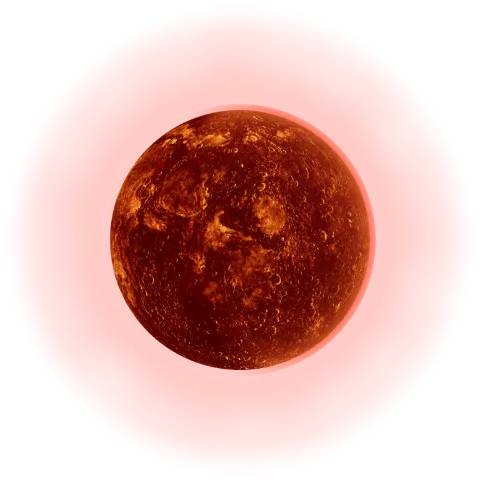
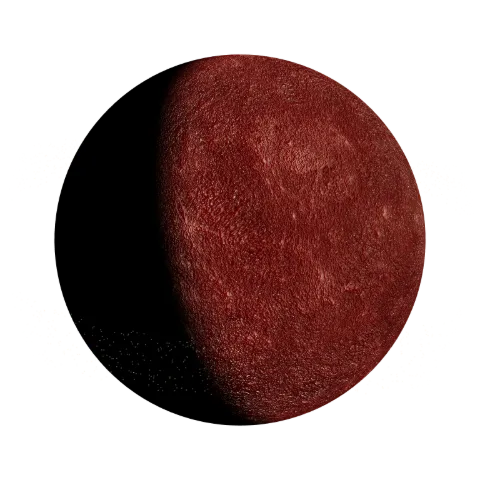
The hottest planet known: its dayside reaches about 4,600 K, hotter than many stars. Molecules are torn apart, iron and titanium float as vapour, and its blue-white star boils the atmosphere away into a trailing tail.
- Radius
- 1.94 × Jupiter
- Temperature
- 3,921 K (3,648 °C)
- From Earth
- 667 light‑years
- Temperature
- Over 4,300 °C on the dayside: hotter than many stars
- Air
- Molecules torn apart; iron and titanium float as vapour
- Metal weather
- Iron may condense on the cooler night side, then boil again by day
- Losing air
- Up to about 10 million tonnes a second, streaming away in a tail
- Fate
- Swallowed when its star swells into a red giant
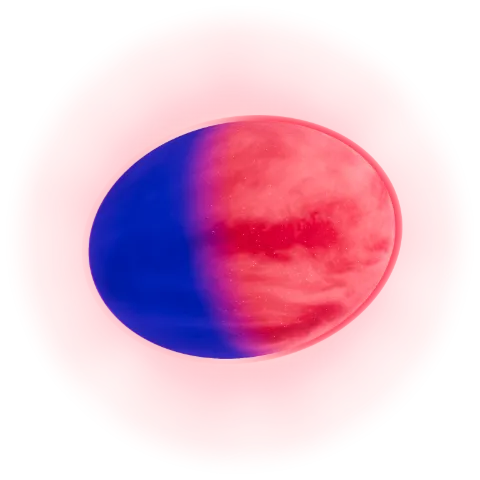
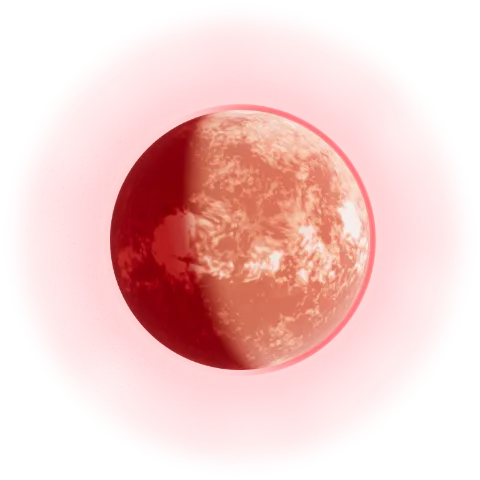
One side always faces its blue-white star, here vast and low on the horizon. The glowing streaks stand for iron condensing into droplets as the wind carries it towards the night. There is no ground to stand on here, so you hover on a small platform: no one could survive here, and the colours are educated guesses.
Hottest Planet at a glance
- Status
- Confirmed planet
- Radius
- 1.94 × Jupiter
- Mass
- 2.88 × Jupiter
- Year length
- 1.48 days
- Temperature
- 3,921 K (3,648 °C)
- Host star
- KELT-9 (A-type)
- From Earth
- 667 light-years
- Discovered
- 2017 · Transit
- Data
- NASA Exoplanet Archive
Facts
- A gas giant about three times heavier than Jupiter, 670 light-years away.
- It is so hot that molecules like water and carbon dioxide are torn apart, and heavy metals like iron and titanium turn into gas.
- It orbits a massive, blazing blue star so tightly that its year is under 1½ days, with one side permanently facing it.
- That day side reaches over 4,200 °C (7,700 °F).
- Metals may cycle endlessly: evaporating on the day side, blown to the cooler night side to condense, then carried back again.
- The radiation puffs it up like a balloon, and its star strips away about 10 million tonnes of it every second, trailing behind like a giant comet’s tail.
- Its fate is grim: in under a billion years its star should swell into a red giant and swallow it.
History and research
It was found by KELT, the Kilodegree Extremely Little Telescope: two robotic cameras built around ordinary photographic lenses, one in Arizona and one in South Africa. Scott Gaudi’s team announced it in 2017. It orbits almost over its star’s poles.
In 2018 Jens Hoeijmakers’s team found iron and titanium in its air as single atoms, picked out from the starlight filtering through it. On cooler planets those metals hide inside molecules and clouds. Here the heat had split them apart.
Sources: Wikipedia: KELT-9b. Checked 27 October 2026.
How big is Hottest Planet?
Hottest Planet is 276,514 km across: 1.98 times as wide as Jupiter.
Illustrations from NASA
Questions about Hottest Planet
How far away is KELT-9b?
667 light-years from Earth. Even at the speed of light, the trip would take 667 years.
How big is KELT-9b?
Its radius is 1.94 times Jupiter’s, about 21.7 times as wide as Earth.
How long is a year on KELT-9b?
It goes once round its star in 1.48 days. How old would you be there? →
How hot is KELT-9b?
About 3,921 K (3,648 °C).
What would I weigh on KELT-9b?
At the cloud tops (there is no ground to stand on), gravity is 19.1 m/s², 1.94 times Earth’s. Scales that read 50 kg on Earth would read about 97.2 kg on KELT-9b. Work out your own weight there →
When was KELT-9b discovered?
In 2017, by the transit method: the slight dip in its star’s light each time the planet passes in front of it.
More Exoplanets
All planetsHot PlanetsPulsing-Star PlanetWASP-33b · Ultra-hot JupiterRadius1.59 × JupiterTemperature2,782 K (2,509 °C) Hot PlanetsDoomed PlanetWASP-12b · Ultra-hot JupiterRadius1.97 × JupiterTemperature2,601 K (2,328 °C) Hot PlanetsGem-Rain PlanetWASP-121b · Ultra-hot JupiterRadius1.74 × JupiterTemperature2,409 K (2,136 °C) Hot PlanetsIron Rain WorldWASP-76 b · Ultra-hot JupiterRadius1.83 × JupiterTemperature2,160 K (1,887 °C) Hot PlanetsMirror PlanetLTT 9779 b · Ultra-hot NeptuneRadius4.72 × EarthTemperature1,978 K (1,705 °C) Hot PlanetsLava-Ocean World55 Cancri e (Janssen) · Super-Earth lava worldRadius1.88 × EarthTemperature1,958 K (1,685 °C) Hot PlanetsNaked CoreTOI-849 b · Exposed planetary coreRadius3.64 × EarthTemperature1,932 K (1,659 °C) Hot PlanetsDarkest Planet KnownTrES-2b · Hot JupiterRadius1.36 × JupiterTemperature1,466 K (1,193 °C)