Strange Planets
Backwards Planet
WASP-17b · Puffy hot Jupiter
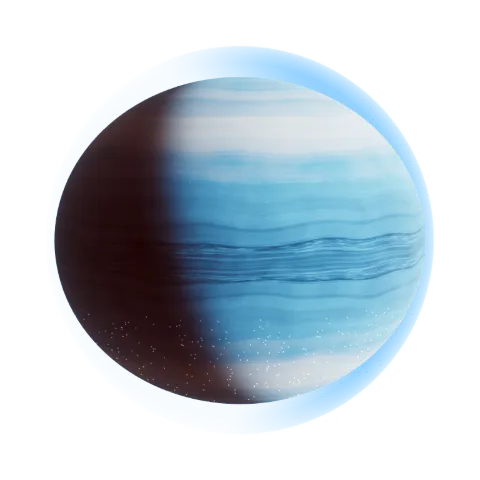
Nearly twice Jupiter’s width but with less of its mass, making it one of the puffiest planets known. It orbits backwards, against its star’s spin, and JWST found tiny quartz crystals glittering in its high clouds.
- Radius
- 1.87 × Jupiter
- Temperature
- 1,755 K (1,482 °C)
- From Earth
- 1,324 light‑years
- Clouds
- Tiny quartz crystals, formed straight from hot gas (JWST, 2023)
- Orbit
- Backwards, against its star’s spin: the first such planet found
- Size
- Nearly twice Jupiter’s width, but half its mass
- Density
- So low it would float in a large enough bathtub
- Temperature
- About 1,500 °C
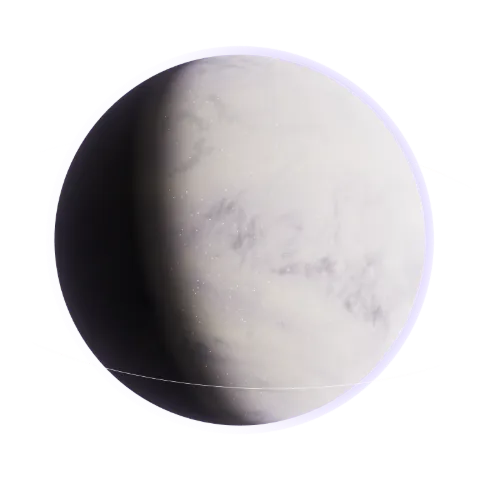
The glittering motes are the quartz crystals, drawn much larger than they are (they are smaller than a grain of flour). There is no ground to stand on here, so you hover on a small platform: no one could survive here, and the colours are educated guesses.
Backwards Planet at a glance
- Status
- Confirmed planet
- Radius
- 1.87 × Jupiter
- Mass
- 0.78 × Jupiter
- Year length
- 3.74 days
- Temperature
- 1,755 K (1,482 °C)
- Host star
- WASP-17 (F4)
- From Earth
- 1,324 light-years
- Discovered
- 2009 · Transit
- Data
- NASA Exoplanet Archive
Facts
- Also called Ditsö̀, from Talamancan mythology: the god who gave names to the first people.
- The first planet discovered on a retrograde orbit, travelling backwards against the way its star spins.
- That shocked scientists. It may have been flung into its backward loop by a near collision with another planet, or a gravitational struggle.
- It is a monster almost twice as wide as Jupiter, yet only half as heavy: so puffy it would float in a big enough bathtub, like a beach ball.
- In 2023 JWST found clouds made of quartz. At around 1,500 °C (2,700 °F), the crystals form straight from the gas.
History and research
David Anderson’s team at Keele University found it in 2009. They showed it orbits backwards using the starlight it blocks: a spinning star’s one edge moves towards us and the other away, and the planet covers the receding edge first.
In 2023 David Grant’s team used Webb to find the quartz. It was the first time silica had been identified in a planet’s clouds.
Sources: Wikipedia: WASP-17b. Checked 27 October 2026.
How big is Backwards Planet?
Backwards Planet is 267,085 km across: 1.91 times as wide as Jupiter.
Illustrations from NASA
Questions about Backwards Planet
How far away is WASP-17b?
1,324 light-years from Earth. Even at the speed of light, the trip would take 1,324 years.
How big is WASP-17b?
Its radius is 1.87 times Jupiter’s, about 21 times as wide as Earth.
How long is a year on WASP-17b?
It goes once round its star in 3.74 days. How old would you be there? →
How hot is WASP-17b?
About 1,755 K (1,482 °C).
What would I weigh on WASP-17b?
At the cloud tops (there is no ground to stand on), gravity is 5.54 m/s², 56% of Earth’s. Scales that read 50 kg on Earth would read about 28.2 kg on WASP-17b. Work out your own weight there →
When was WASP-17b discovered?
In 2009, by the transit method: the slight dip in its star’s light each time the planet passes in front of it.
More Exoplanets
All planetsStrange PlanetsBurning Ice WorldGliese 436 b · Warm NeptuneRadius4.17 × EarthTemperature686 K (413 °C) Strange PlanetsThe Vanishing PlanetFomalhaut b (Dagon) · Former planet: a dust cloudFrom Earth25.0 light‑years Strange PlanetsStarless WandererPSO J318.5-22 · Rogue planetTemperature1,127 K (854 °C)From Earth72.0 light‑years Strange PlanetsAurora WorldYZ Ceti b · Rocky planetRadius0.913 × EarthTemperature471 K (198 °C) Strange PlanetsFar-Flung GiantHD 106906 b · Wide-orbit giantRadius1.11 × JupiterTemperature1,800 K (1,527 °C) Strange PlanetsSteel-Dense PlanetTOI-1853 b · Ultra-dense NeptuneRadius3.46 × EarthTemperature1,479 K (1,206 °C) Strange PlanetsEight-Hour-Day GiantBeta Pictoris b · Young giant planetRadius1.65 × JupiterTemperature1,612 K (1,339 °C) Strange PlanetsCotton Candy PlanetWASP-107 b · Super-puffRadius0.937 × JupiterTemperature740 K (467 °C)