Strange Planets
Starless Wanderer
PSO J318.5-22 · Rogue planet
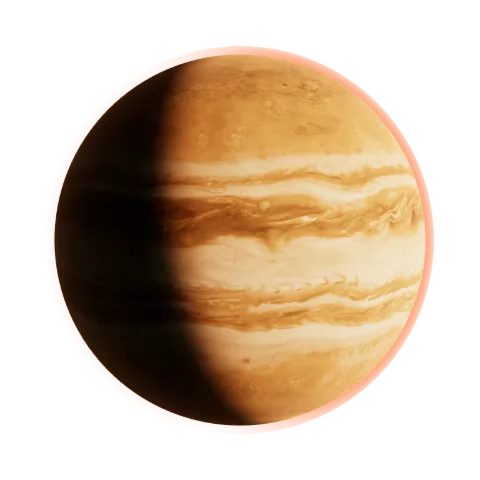
A planet without a sun, drifting alone through space. About 8 times Jupiter’s mass, it still glows at roughly 1,100 K with the heat of its formation 23 million years ago, and with no star it will only cool and darken.

- Temperature
- 1,127 K (854 °C)
- From Earth
- 72.0 light‑years
- Mass
- 8.3 × Jupiter
- Sun
- None: it drifts alone between the stars
- Heat
- About 850 °C, left over from its birth 23 million years ago
- Clouds
- Hot dust and quartz grains high up; liquid iron deeper down
- Weather
- Storms that sweep round every few hours as it spins
- Mass
- About 8 × Jupiter
The only light is the planet’s own: a dull red glow from below. There is no ground to stand on here, so you hover on a small platform: no one could survive here, and the colours are educated guesses.
Starless Wanderer at a glance
- Status
- Confirmed, with no host star
- Mass
- 8.3 × Jupiter
- Temperature
- 1,127 K (854 °C)
- Day length
- ≈ 8.5 hours
- Host star
- None (free-floating)
- From Earth
- 72.0 light-years
- Discovered
- 2013 · Infrared survey (Pan-STARRS)
- Data
- Published studies
Facts
- A rogue planet: the sun never rises here, because there is no sun at all.
- It may have been kicked out of its home system soon after forming, or formed all by itself, to float forever in the void between stars.
- You’d expect a frozen ball of ice, but it is a burning furnace: Jupiter-sized but about 8 times heavier, and only about 23 million years old, it still glows with the heat of its birth.
- Its brightness changes as stormy clouds rotate around it every few hours.
- Those clouds are hot dust and molten metal. JWST suggests the highest are tiny grains of quartz, or sand, with heavy clouds of liquid iron deeper down.
History and research
Michael Liu’s team found it in 2013 in data from Pan-STARRS, a survey telescope in Hawaii, while looking for brown dwarfs. Its name is a sky position, and its odd red colour flagged it as young.
It belongs to the Beta Pictoris moving group, young stars, and it is about 70 light-years away that formed together. That gave its age and, from its glow, its mass. In 2018 Spitzer measured its brightness changing as it spins, roughly every 5 hours.
Sources: Wikipedia: PSO J318.5−22. Checked 27 October 2026.
How big is Starless Wanderer?
Starless Wanderer is 214,238 km across: 1.53 times as wide as Jupiter.
Questions about Starless Wanderer
How far away is PSO J318.5-22?
72.0 light-years from Earth. Even at the speed of light, the trip would take 72.0 years.
How hot is PSO J318.5-22?
About 1,127 K (854 °C).
When was PSO J318.5-22 discovered?
In 2013, by infrared survey (Pan-STARRS).
More Exoplanets
All planetsStrange PlanetsAurora WorldYZ Ceti b · Rocky planetRadius0.913 × EarthTemperature471 K (198 °C) Strange PlanetsFar-Flung GiantHD 106906 b · Wide-orbit giantRadius1.11 × JupiterTemperature1,800 K (1,527 °C) Strange PlanetsSteel-Dense PlanetTOI-1853 b · Ultra-dense NeptuneRadius3.46 × EarthTemperature1,479 K (1,206 °C) Strange PlanetsEight-Hour-Day GiantBeta Pictoris b · Young giant planetRadius1.65 × JupiterTemperature1,612 K (1,339 °C) Strange PlanetsCotton Candy PlanetWASP-107 b · Super-puffRadius0.937 × JupiterTemperature740 K (467 °C) Strange PlanetsPossible Ocean WorldTOI-1452 b · Super-EarthRadius1.67 × EarthTemperature326 K (53 °C) Strange PlanetsVolcano WorldLP 791-18 d · Earth-sized planetRadius1.03 × EarthFrom Earth86.0 light‑years ExoplanetsDimidium51 Pegasi b · Hot JupiterTemperature1,260 K (987 °C)From Earth50.6 light‑years