Strange Planets
Burning Ice World
Gliese 436 b · Warm Neptune
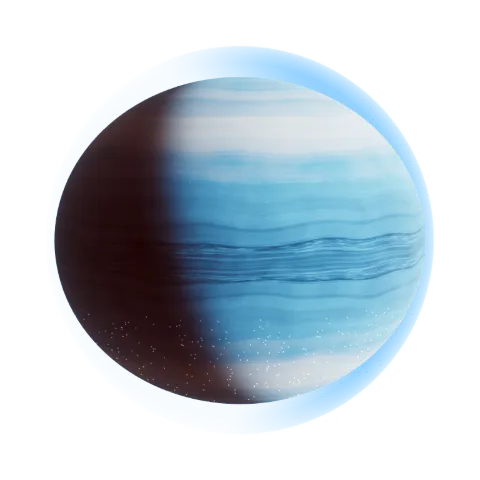
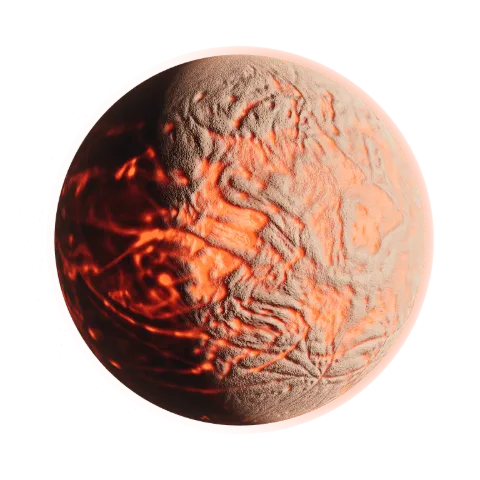
A Neptune-sized world thought to hold ice that stays solid above 400 °C, squeezed into exotic forms by crushing pressure. It also trails a vast comet-like cloud of hydrogen boiling off its atmosphere.
- Radius
- 4.17 × Earth
- Temperature
- 686 K (413 °C)
- From Earth
- 31.8 light‑years
- Inside
- “Hot ice”: water crushed solid though it is over 400 °C
- Temperature
- About 440 °C, hot enough to melt lead
- Tail
- Hydrogen streaming over 12 million km behind it, like a comet
- Orbit
- Over its star’s poles, sideways to the usual direction
- Sun
- A red dwarf, only 3% as far as the Sun is from Earth
Its air holds carbon monoxide instead of the methane models predicted. The comet-like tail shines only in ultraviolet, so you can’t see it here. There is no ground to stand on here, so you hover on a small platform: no one could survive here, and the colours are educated guesses.
Burning Ice World at a glance
- Status
- Confirmed planet
- Radius
- 4.17 × Earth
- Mass
- 22.1 × Earth
- Year length
- 2.64 days
- Orbit eccentricity
- 0.14
- Temperature
- 686 K (413 °C)
- Host star
- GJ 436 (M2.5 V red dwarf)
- From Earth
- 31.8 light-years
- Discovered
- 2004 · Radial velocity
- Data
- NASA Exoplanet Archive
Facts
- Its name, Awohali, is the Cherokee word for eagle, after a legend in which an eagle flies to the Sun and the Sun kisses its tail feather.
- Fittingly, its star blasts it so hard that a cloud of hydrogen over 12 million km (8 million miles) long trails behind it, like a colossal comet.
- It sits only about 3% of the Earth–Sun distance from its star, losing air at a terrifying rate.
- It orbits over its star’s poles, a nearly vertical loop: sideways compared to how a planet should orbit.
- “Hot burning ice”: at about 440 °C (820 °F), hot enough to melt lead, its interior may still hold ice, crushed solid by the pressure.
- Its air is chemically “wrong”, full of carbon monoxide instead of the methane models predicted.
- A hidden, massive companion planet may have pushed it onto this path, leaving it to be slowly eaten by its star while the culprit hides in the dark.
History and research
Paul Butler and Geoffrey Marcy found it in 2004 with the Keck telescope in Hawaii: one of the first planets known with a mass close to Neptune’s. In 2007 Michaël Gillon’s team caught it crossing its star, which gave its size and showed that it had to be mostly water ice and rock.
In 2015 David Ehrenreich’s team used Hubble’s ultraviolet camera to find the huge cloud of hydrogen trailing behind it. Three years later his group showed that it travels over its star’s poles, a hint that something, perhaps an unseen planet, pushed it there.
Sources: Wikipedia: Gliese 436 b. Checked 27 October 2026.
How big is Burning Ice World?
Burning Ice World is 53,134 km across: 4.17 times as wide as Earth.
Illustrations from NASA
Questions about Burning Ice World
How far away is Gliese 436 b?
31.8 light-years from Earth. Even at the speed of light, the trip would take 31.8 years.
How big is Gliese 436 b?
Its radius is 4.17 times Earth’s, about 4.2 times as wide as Earth.
How long is a year on Gliese 436 b?
It goes once round its star in 2.64 days. How old would you be there? →
How hot is Gliese 436 b?
About 686 K (413 °C).
What would I weigh on Gliese 436 b?
At the cloud tops (there is no ground to stand on), gravity is 12.5 m/s², 1.27 times Earth’s. Scales that read 50 kg on Earth would read about 63.5 kg on Gliese 436 b. Work out your own weight there →
When was Gliese 436 b discovered?
In 2004, by the radial-velocity method: the slight wobble the planet’s pull gives its star.
More Exoplanets
All planetsStrange PlanetsThe Vanishing PlanetFomalhaut b (Dagon) · Former planet: a dust cloudFrom Earth25.0 light‑years Strange PlanetsStarless WandererPSO J318.5-22 · Rogue planetTemperature1,127 K (854 °C)From Earth72.0 light‑years Strange PlanetsAurora WorldYZ Ceti b · Rocky planetRadius0.913 × EarthTemperature471 K (198 °C) Strange PlanetsFar-Flung GiantHD 106906 b · Wide-orbit giantRadius1.11 × JupiterTemperature1,800 K (1,527 °C) Strange PlanetsSteel-Dense PlanetTOI-1853 b · Ultra-dense NeptuneRadius3.46 × EarthTemperature1,479 K (1,206 °C) Strange PlanetsEight-Hour-Day GiantBeta Pictoris b · Young giant planetRadius1.65 × JupiterTemperature1,612 K (1,339 °C) Strange PlanetsCotton Candy PlanetWASP-107 b · Super-puffRadius0.937 × JupiterTemperature740 K (467 °C) Strange PlanetsPossible Ocean WorldTOI-1452 b · Super-EarthRadius1.67 × EarthTemperature326 K (53 °C)