Strange Planets
Eight-Hour-Day Giant
Beta Pictoris b · Young giant planet
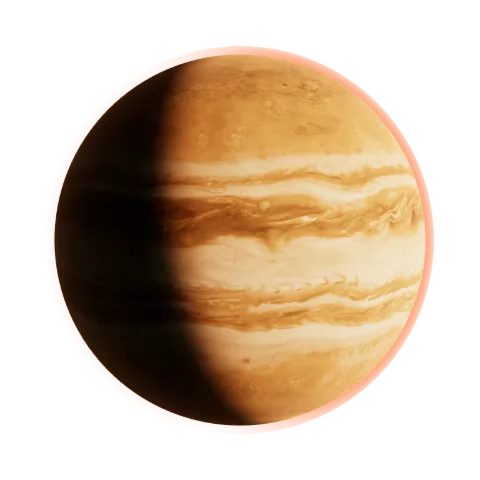
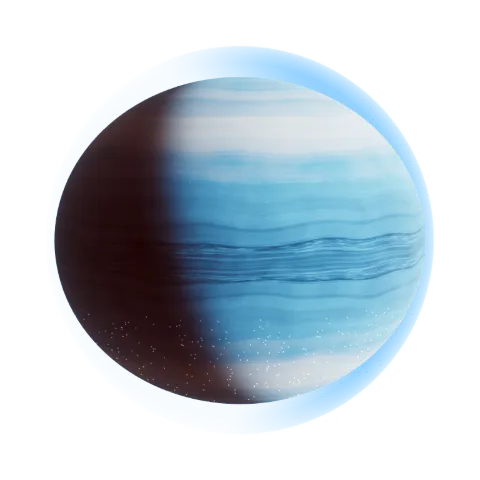
A young giant, only about 20 million years old, still glowing from its formation inside its star’s huge debris disk. In 2014 it became the first exoplanet with a measured day length: about 8 hours, shorter than any planet’s in the Solar System.
- Radius
- 1.65 × Jupiter
- Temperature
- 1,612 K (1,339 °C)
- From Earth
- 64.4 light‑years
- One day
- About 8 hours
- Spin
- Its equator turns at about 100,000 km/h
- Shape
- Flattened at the poles and bulging at the middle
- Your weight
- Less at the equator than at the poles
- Age
- About 20 million years, still glowing from its birth
The band across the sky is its star’s huge disk of debris. There is no ground to stand on here, so you hover on a small platform: no one could survive here, and the colours are educated guesses.
Eight-Hour-Day Giant at a glance
- Status
- Confirmed planet
- Radius
- 1.65 × Jupiter
- Mass
- 8.7 × Jupiter
- Year length
- 8,680 days
- Orbit eccentricity
- 0.10
- Temperature
- 1,612 K (1,339 °C)
- Day length
- ≈ 8–9 hours
- Host star
- Beta Pictoris (A6 V)
- From Earth
- 64.4 light-years
- Discovered
- 2008 · Imaging
- Data
- NASA Exoplanet Archive
Facts
- If you stood on this planet, your body weight would trick you.
- A gas giant around 10 times heavier than Jupiter (estimates vary), spinning so fast a day lasts only 8 hours.
- Its equator spins at about 100,000 km/h (62,000 mph).
- The spin bends it out of shape: flattened top and bottom, stretched in the middle, like a spinning top about to fly apart.
- At the poles its gravity would crush you; at the equator the spin fights the pull, so you would weigh much less.
- It spins so fast it is almost throwing its own air off into space.
History and research
In 1984 Bradford Smith and Richard Terrile photographed a flat disk of dust around Beta Pictoris, the first such disk seen around another star. The disk was warped, as if a planet were tugging it. Anne-Marie Lagrange’s team found that planet in VLT images from 2003, announced it in 2008, and confirmed it in 2009 on the other side of its star.
Since the 1980s astronomers have also seen comets falling into the star, which show up as brief changes in its light. A second giant, Beta Pictoris c, was found from its pull on the star in 2019, and in 2020 the GRAVITY instrument at the VLT saw its light directly.
Sources: Wikipedia: Beta Pictoris b, Wikipedia: Beta Pictoris. Checked 27 October 2026.
How big is Eight-Hour-Day Giant?
Eight-Hour-Day Giant is 235,663 km across: 1.69 times as wide as Jupiter.
Questions about Eight-Hour-Day Giant
How far away is Beta Pictoris b?
64.4 light-years from Earth. Even at the speed of light, the trip would take 64.4 years.
How big is Beta Pictoris b?
Its radius is 1.65 times Jupiter’s, about 18.5 times as wide as Earth.
How long is a year on Beta Pictoris b?
It goes once round its star in 8,680 days. How old would you be there? →
How hot is Beta Pictoris b?
About 1,612 K (1,339 °C).
When was Beta Pictoris b discovered?
In 2008, by direct imaging: photographing it as a faint dot beside its star.
More Exoplanets
All planetsStrange PlanetsCotton Candy PlanetWASP-107 b · Super-puffRadius0.937 × JupiterTemperature740 K (467 °C) Strange PlanetsPossible Ocean WorldTOI-1452 b · Super-EarthRadius1.67 × EarthTemperature326 K (53 °C) Strange PlanetsVolcano WorldLP 791-18 d · Earth-sized planetRadius1.03 × EarthFrom Earth86.0 light‑years ExoplanetsDimidium51 Pegasi b · Hot JupiterTemperature1,260 K (987 °C)From Earth50.6 light‑years ExoplanetsOsirisHD 209458 b · Hot JupiterRadius1.36 × JupiterTemperature1,450 K (1,177 °C) ExoplanetsÆgirEpsilon Eridani b · Cold gas giantFrom Earth10.5 light‑yearsMass0.661 × Jupiter ExoplanetsFirst Imaged Planet2M1207 b · Young giant planetTemperature1,250 K (977 °C)From Earth170 light‑years ExoplanetsHazy Sub-NeptuneGJ 1214 b · Sub-NeptuneRadius2.74 × EarthTemperature596 K (323 °C)