Strange Planets
Far-Flung Giant
HD 106906 b · Wide-orbit giant
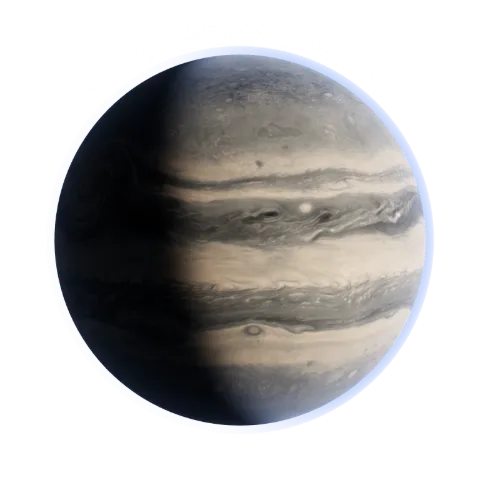
An 11-Jupiter-mass giant circling its twin stars at roughly 700 times the Earth–Sun distance, on a tilted, stretched orbit lasting around 15,000 years. Astronomers treat it as a real-life analogue of the hypothetical Planet Nine.
- Radius
- 1.11 × Jupiter
- Temperature
- 1,800 K (1,527 °C)
- From Earth
- 336 light‑years
- Distance
- About 700 × farther from its suns than Earth is from the Sun
- Suns
- Twin stars, so far off they shine as one dazzling point
- One year
- About 15,000 years
- History
- Flung outwards, then likely caught by a passing star
- Mass
- About 11 × Jupiter, still glowing from its birth
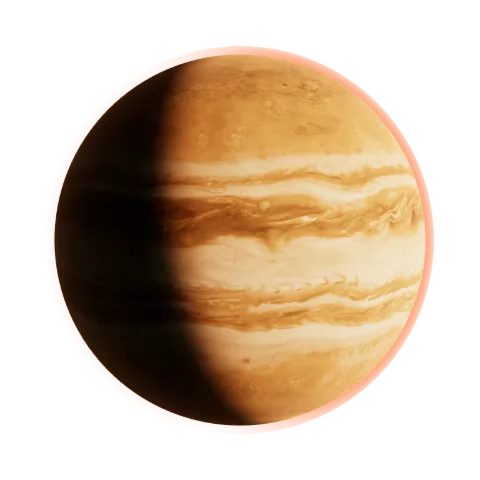
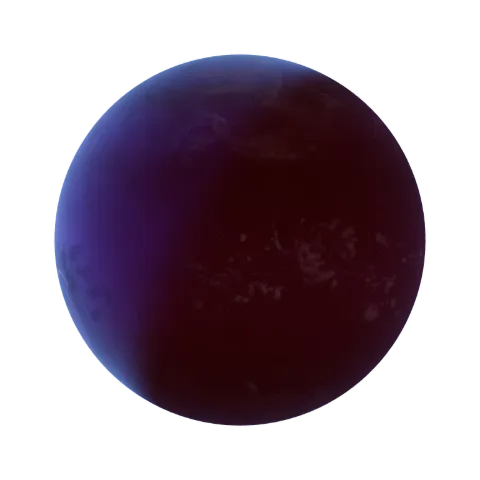
A real-life version of the hypothetical Planet Nine. There is no ground to stand on here, so you hover on a small platform: no one could survive here, and the colours are educated guesses.
Far-Flung Giant at a glance
- Status
- Confirmed planet
- Radius
- 1.11 × Jupiter
- Mass
- 11 × Jupiter
- Temperature
- 1,800 K (1,527 °C)
- Orbit
- ≈ 650–740 AU · ~15,000-year year
- Host star
- HD 106906 (twin F5 V stars)
- From Earth
- 336 light-years
- Discovered
- 2013 · Imaging
- Data
- NASA Exoplanet Archive
Facts
- Sometimes called the exiled planet: a gas giant about 11 times heavier than Jupiter, in an extremely lonely spot.
- It orbits a pair of twin stars from over 700 times the Earth–Sun distance, out at the freezing, dark edge of its system.
- It shouldn’t exist there: so far out, there was never enough material to build a planet that big.
- It likely formed close to its stars, until their gravity slingshot it outwards, nearly throwing it out to become a rogue planet.
- A passing star probably nudged the runaway just enough to lock it into a tilted orbit that takes about 15,000 years.
History and research
Vanessa Bailey’s team at the University of Arizona found it in 2013 with the Magellan telescope in Chile. The star turned out to be two stars orbiting each other closely. Its dust disk is lopsided, which the planet’s pull may explain.
In 2020 Meiji Nguyen and Paul Kalas used 14 years of Hubble images to measure its motion across the sky. Small shifts over that time were enough to show that its orbit is tilted and very stretched, and to compare it with Planet Nine, the unseen planet some astronomers suspect beyond Neptune.
Sources: Wikipedia: HD 106906 b. Checked 27 October 2026.
How big is Far-Flung Giant?
Far-Flung Giant is 158,001 km across: 1.13 times as wide as Jupiter.
Questions about Far-Flung Giant
How far away is HD 106906 b?
336 light-years from Earth. Even at the speed of light, the trip would take 336 years.
How big is HD 106906 b?
Its radius is 1.11 times Jupiter’s, about 12.4 times as wide as Earth.
How hot is HD 106906 b?
About 1,800 K (1,527 °C).
When was HD 106906 b discovered?
In 2013, by direct imaging: photographing it as a faint dot beside its star.
More Exoplanets
All planetsStrange PlanetsSteel-Dense PlanetTOI-1853 b · Ultra-dense NeptuneRadius3.46 × EarthTemperature1,479 K (1,206 °C) Strange PlanetsEight-Hour-Day GiantBeta Pictoris b · Young giant planetRadius1.65 × JupiterTemperature1,612 K (1,339 °C) Strange PlanetsCotton Candy PlanetWASP-107 b · Super-puffRadius0.937 × JupiterTemperature740 K (467 °C) Strange PlanetsPossible Ocean WorldTOI-1452 b · Super-EarthRadius1.67 × EarthTemperature326 K (53 °C) Strange PlanetsVolcano WorldLP 791-18 d · Earth-sized planetRadius1.03 × EarthFrom Earth86.0 light‑years ExoplanetsDimidium51 Pegasi b · Hot JupiterTemperature1,260 K (987 °C)From Earth50.6 light‑years ExoplanetsOsirisHD 209458 b · Hot JupiterRadius1.36 × JupiterTemperature1,450 K (1,177 °C) ExoplanetsÆgirEpsilon Eridani b · Cold gas giantFrom Earth10.5 light‑yearsMass0.661 × Jupiter