Strange Planets
Cotton Candy Planet
WASP-107 b · Super-puff
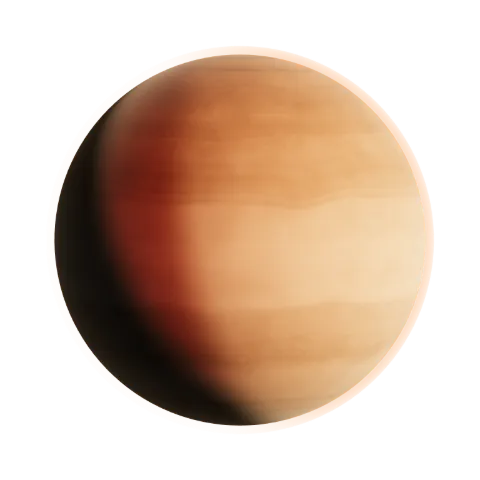
A planet nearly as wide as Jupiter with less than a tenth of its mass, one of the least dense planets known. Webb found clouds of sand-like silicate particles in its air.
- Radius
- 0.937 × Jupiter
- Temperature
- 740 K (467 °C)
- From Earth
- 211 light‑years
Cotton Candy Planet at a glance
- Status
- Confirmed planet
- Radius
- 0.937 × Jupiter
- Mass
- 30.5 × Earth
- Year length
- 5.72 days
- Temperature
- 740 K (467 °C)
- Host star
- WASP-107, an orange dwarf
- From Earth
- 211 light-years
- Discovered
- 2017 · Transit
- Data
- Published studies
Facts
- It is about as dense as cotton candy, around a tenth of the density of water.
- In 2024 studies found its interior is much hotter than expected, heated by tides from its slightly oval orbit, which puffs it up.
- Its atmosphere is escaping in a long tail of helium.
- Its gravity at the cloud tops is only about a quarter of Earth’s.
- Its star is an orange dwarf with about two-thirds of the Sun’s mass.
History and research
The WASP survey found it in 2017, about 200 light-years away in Virgo. In 2018 Jessica Spake’s team used Hubble to find helium escaping from it: the first helium ever detected in the air of a planet outside the Solar System.
Webb studies in 2023 found sulfur dioxide and silicate clouds, and in 2024 two teams measured very little methane in it. That shortage was the clue that its inside is hotter than expected.
Sources: Wikipedia: WASP-107b. Checked 27 October 2026.
How big is Cotton Candy Planet?
Cotton Candy Planet is 133,791 km across: 10.5 times as wide as Earth.
Questions about Cotton Candy Planet
How far away is WASP-107 b?
211 light-years from Earth. Even at the speed of light, the trip would take 211 years.
How big is WASP-107 b?
Its radius is 0.937 times Jupiter’s, about 10.5 times as wide as Earth.
How long is a year on WASP-107 b?
It goes once round its star in 5.72 days. How old would you be there? →
How hot is WASP-107 b?
About 740 K (467 °C).
What would I weigh on WASP-107 b?
At the cloud tops (there is no ground to stand on), gravity is 2.71 m/s², 28% of Earth’s. Scales that read 50 kg on Earth would read about 13.8 kg on WASP-107 b. Work out your own weight there →
When was WASP-107 b discovered?
In 2017, by the transit method: the slight dip in its star’s light each time the planet passes in front of it.
More Exoplanets
All planetsStrange PlanetsPossible Ocean WorldTOI-1452 b · Super-EarthRadius1.67 × EarthTemperature326 K (53 °C) Strange PlanetsVolcano WorldLP 791-18 d · Earth-sized planetRadius1.03 × EarthFrom Earth86.0 light‑years ExoplanetsDimidium51 Pegasi b · Hot JupiterTemperature1,260 K (987 °C)From Earth50.6 light‑years ExoplanetsOsirisHD 209458 b · Hot JupiterRadius1.36 × JupiterTemperature1,450 K (1,177 °C) ExoplanetsÆgirEpsilon Eridani b · Cold gas giantFrom Earth10.5 light‑yearsMass0.661 × Jupiter ExoplanetsFirst Imaged Planet2M1207 b · Young giant planetTemperature1,250 K (977 °C)From Earth170 light‑years ExoplanetsHazy Sub-NeptuneGJ 1214 b · Sub-NeptuneRadius2.74 × EarthTemperature596 K (323 °C) ExoplanetsReal TatooineKepler-16 b · Circumbinary gas giantRadius0.754 × JupiterTemperature188 K (-85 °C)