Strange Planets
Dead-Star Planets
PSR B1257+12 · Planets orbiting a dead star
The first exoplanets ever confirmed (1992), found around a pulsar: the collapsed core of an exploded star, spinning 161 times a second and sweeping beams of radiation past its three planets, Draugr, Poltergeist and Phobetor.
- From Earth
- 1,957 light‑years
- Sun
- The pulsar “Lich”, a dead star’s core spinning 161 times a second
- Light
- Flashes 161 times a second: too fast to see, so it looks steady
- Radiation
- Deadly and constant, enough to sterilise the surface
- Neighbours
- Two more planets, Phobetor and Draugr, seen as points of light
- Origin
- Perhaps rebuilt from debris after the star’s death
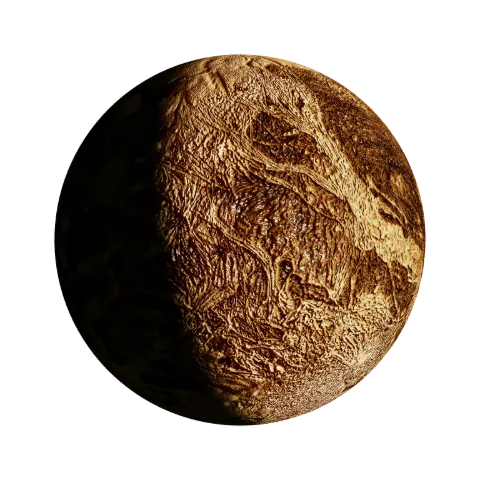
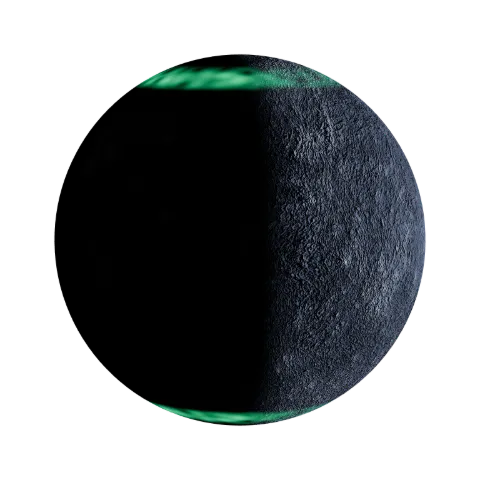
The first planets ever confirmed beyond the Solar System (1992). Nothing of their surfaces has been seen: this is an impression of an airless rocky world (any air would have been stripped away by the pulsar). Hence the black sky full of stars, and the hard shadows.
Dead-Star Planets at a glance
- Status
- Confirmed planet
- Draugr (b)
- 0.02 × Earth mass · 25.3 days
- Poltergeist (c)
- 4.3 × Earth mass · 66.5 days
- Phobetor (d)
- 3.9 × Earth mass · 98.2 days
- Host star
- Millisecond pulsar “Lich”
- From Earth
- 1,957 light-years
- Discovered
- 1992 · Pulsar timing
- Data
- NASA Exoplanet Archive
Facts
- Astronomers named this star and its planets after monsters and the undead.
- The star, “Lich”, is named after a fictional creature that uses magic to control the dead. It is a pulsar: a neutron star that sweeps beams of energy around like a lighthouse.
- It spins about 160 times every second, and its surface reaches nearly 29,000 °C (52,000 °F).
- Its three planets, Draugr, Poltergeist and Phobetor, were the very first exoplanets ever confirmed, in the early 1990s.
- Standing on one, you would be bathed in constant, deadly radiation that sterilises everything.
- The sky would not hold a steady sun but a strobe light, flashing about 160 times a second (too fast for the eye to see as flicker).
- The planets are “zombies” themselves: they likely formed from debris left after two white dwarf stars crashed and merged billions of years ago.
History and research
Aleksander Wolszczan and Dale Frail found the planets in 1992 with the Arecibo radio telescope in Puerto Rico. They timed the pulsar’s flashes and saw them arrive a little early, then a little late, as the planets swung it back and forth.
A few days before they presented, Andrew Lyne withdrew his own 1991 claim of a pulsar planet: a mistake in correcting for Earth’s motion had made it. Wolszczan and Frail’s result held up, and a third planet was confirmed in 1994. The pulsar is about 2,300 light-years away in Virgo.
Sources: Wikipedia: PSR B1257+12. Checked 27 October 2026.
How big is Dead-Star Planets?
Dead-Star Planets is 19,113 km across: 1.5 times as wide as Earth.
Questions about Dead-Star Planets
How far away is PSR B1257+12?
1,957 light-years from Earth. Even at the speed of light, the trip would take 1,957 years.
When was PSR B1257+12 discovered?
In 1992, by pulsar timing: tiny shifts in the clockwork pulses of the dead star it circles.
More Exoplanets
All planetsStrange PlanetsBackwards PlanetWASP-17b · Puffy hot JupiterRadius1.87 × JupiterTemperature1,755 K (1,482 °C) Strange PlanetsBurning Ice WorldGliese 436 b · Warm NeptuneRadius4.17 × EarthTemperature686 K (413 °C) Strange PlanetsThe Vanishing PlanetFomalhaut b (Dagon) · Former planet: a dust cloudFrom Earth25.0 light‑years Strange PlanetsStarless WandererPSO J318.5-22 · Rogue planetTemperature1,127 K (854 °C)From Earth72.0 light‑years Strange PlanetsAurora WorldYZ Ceti b · Rocky planetRadius0.913 × EarthTemperature471 K (198 °C) Strange PlanetsFar-Flung GiantHD 106906 b · Wide-orbit giantRadius1.11 × JupiterTemperature1,800 K (1,527 °C) Strange PlanetsSteel-Dense PlanetTOI-1853 b · Ultra-dense NeptuneRadius3.46 × EarthTemperature1,479 K (1,206 °C) Strange PlanetsEight-Hour-Day GiantBeta Pictoris b · Young giant planetRadius1.65 × JupiterTemperature1,612 K (1,339 °C)