Strange Planets
Three-Sun World
HD 188753 Ab · Hot Jupiter (unconfirmed)
Announced in 2005 as a real “Tatooine”: a hot Jupiter racing around one star of a tight triple system, with three suns in its sky. Theory said no giant planet could form there, and a 2007 follow-up found no trace of it, so it may not exist.
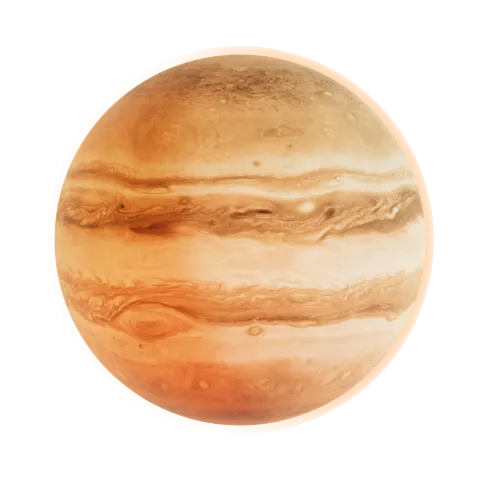
- From Earth
- 150 light‑years
- Year length
- 3.35 days
- Suns
- Three: a yellow star like the Sun, and a pair of smaller stars circling each other
- Shadows
- One for each sun, pointing different ways
- Night
- Maybe never truly dark, as the suns take turns
- One year
- 3.5 days around the main star
- Mystery
- It shouldn’t have had room to form, and a 2007 search found no trace of it
The main sun is drawn at its real size, setting on the horizon. The distant pair is drawn farther apart and brighter than it would be, so each casts its own shadow on the platform. The planet itself may not exist. There is no ground to stand on here, so you hover on a small platform: no one could survive here, and the colours are educated guesses.
Three-Sun World at a glance
- Status
- Unconfirmed: not seen in follow-up
- Year length
- 3.35 days
- Claimed mass
- ≥ 1.14 × Jupiter
- Host star
- Triple star system HD 188753
- From Earth
- 150 light-years
- Discovered
- 2005 · Radial velocity (claimed)
- Data
- Published studies
Facts
- The first planet ever reported in a tight triple star system: a yellow star much like the Sun, plus two smaller stars dancing around each other as they circle it.
- From a moon of this giant, one sun would set only to be followed by a second, then a third, and true darkness might never come.
- Your shadow would split three ways, one for each sun.
- It is a gas giant a little heavier than Jupiter, racing around its main star in just 3½ days.
- That is the mystery: giants are thought to form far out where dust is plentiful and drift inward later, but here the other two stars would have cut off the supply. There should not have been room for it to grow.
- It may be a ghost. Announced in 2005, it was searched for again in 2007 with more precise instruments, and nothing was found. No update has confirmed it since.
History and research
Maciej Konacki announced it in Nature in July 2005, using the Keck telescope and a method of his own to separate the light of the three stars. The system lies about 150 light-years away in Cygnus.
A team from the Geneva Observatory looked again over 2005 and 2006 and published in 2007 that the wobble was not there. Their measurements could have caught a planet like the one claimed. Without a confirmation, catalogues no longer count it.
Sources: Wikipedia: HD 188753. Checked 27 October 2026.
How big is Three-Sun World?
Three-Sun World is 157,108 km across: 1.12 times as wide as Jupiter.
Illustrations from NASA
Questions about Three-Sun World
How far away is HD 188753 Ab?
150 light-years from Earth. Even at the speed of light, the trip would take 150 years.
How long is a year on HD 188753 Ab?
It goes once round its star in 3.35 days. How old would you be there? →
When was HD 188753 Ab discovered?
In 2005, by radial velocity (claimed).
More Exoplanets
All planetsStrange PlanetsDead-Star PlanetsPSR B1257+12 · Planets orbiting a dead starFrom Earth1,957 light‑years Strange PlanetsBackwards PlanetWASP-17b · Puffy hot JupiterRadius1.87 × JupiterTemperature1,755 K (1,482 °C) Strange PlanetsBurning Ice WorldGliese 436 b · Warm NeptuneRadius4.17 × EarthTemperature686 K (413 °C) Strange PlanetsThe Vanishing PlanetFomalhaut b (Dagon) · Former planet: a dust cloudFrom Earth25.0 light‑years Strange PlanetsStarless WandererPSO J318.5-22 · Rogue planetTemperature1,127 K (854 °C)From Earth72.0 light‑years Strange PlanetsAurora WorldYZ Ceti b · Rocky planetRadius0.913 × EarthTemperature471 K (198 °C) Strange PlanetsFar-Flung GiantHD 106906 b · Wide-orbit giantRadius1.11 × JupiterTemperature1,800 K (1,527 °C) Strange PlanetsSteel-Dense PlanetTOI-1853 b · Ultra-dense NeptuneRadius3.46 × EarthTemperature1,479 K (1,206 °C)