Hot Planets
Fire-and-Ice Giant
HD 80606 b · Eccentric hot Jupiter
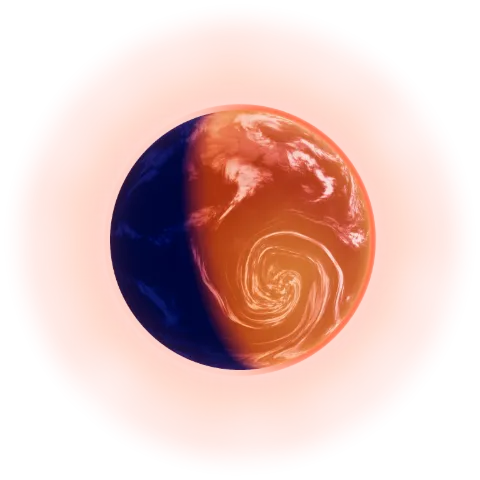
Its orbit is one of the most stretched known. For most of its 111-day year it is far from its star and mild; on its closest pass the dayside heats from about 500 °C to over 1,200 °C within hours, unleashing shock-wave storms.
- Radius
- 1.03 × Jupiter
- Temperature
- 405 K (132 °C)
- From Earth
- 217 light‑years
- Orbit
- Stretched like a comet’s: 111 days out, then a 20-hour dive past the star
- Closest pass
- The sun swells to 30 × the size of ours in Earth’s sky
- Heating
- From about 500 °C to over 1,100 °C in roughly 6 hours
- Storms
- Shock-wave winds of about 18,000 km/h (11,000 mph)
- Cooling
- Under 10 hours, until it fades from infrared telescopes
Time is sped up and looped: the slow swing out lasts 40 seconds here instead of 111 days, and the dive past the star lasts about 10. There is no ground to stand on here, so you hover on a small platform: no one could survive here, and the colours are educated guesses.
Fire-and-Ice Giant at a glance
- Status
- Confirmed planet
- Radius
- 1.03 × Jupiter
- Mass
- 4.16 × Jupiter
- Year length
- 111 days
- Orbit eccentricity
- 0.93
- Temperature
- 405 K (132 °C)
- Host star
- HD 80606 (G5)
- From Earth
- 217 light-years
- Discovered
- 2001 · Radial velocity
- Data
- NASA Exoplanet Archive
Facts
- Known as the “whiplash planet”: its weather can go from freezing to an explosion of heat within hours.
- Its orbit is stretched like a comet’s. For about 100 days it drifts in the cold and dark; then in about 20 hours it dives at its star, swings around it and slingshots back out.
- If Earth came that close, its air would be ripped away and its surface melted into magma.
- In about 6 hours the side facing the star jumps from around 500 °C (930 °F) to over 1,100 °C (2,000 °F), blasted by hundreds of times the energy Earth gets from the Sun.
- From its cloud tops you would watch the sun swell until it looked 30 times bigger than ours does.
- The heat hits so fast the air can’t cope: shock-wave storms blow out from the hot side at around 18,000 km/h (11,000 mph).
- It cools so fast afterwards that within 10 hours it fades from the view of infrared telescopes like Spitzer.
- A star’s pull should round out such an orbit, but this planet seems “stiff” rather than squishy, so it may stay trapped in this torture loop for another 10 billion years.
History and research
A Geneva team led by Dominique Naef found it in 2001. Its star is one of a wide pair in Ursa Major, about 220 light-years away, and the other star is the likely culprit: over long times its pull can stretch a planet’s orbit, then the tides of the planet’s own star slowly shrink it.
In February 2009 several groups caught it crossing its star, among them a team at University College London using the college’s observatory in north London. The crossing showed that its orbit is tilted against the star’s spin, as that tug-of-war would leave it.
Sources: Wikipedia: HD 80606 b. Checked 27 October 2026.
How big is Fire-and-Ice Giant?
Fire-and-Ice Giant is 147,399 km across: 1.05 times as wide as Jupiter.
Illustrations from NASA
Questions about Fire-and-Ice Giant
How far away is HD 80606 b?
217 light-years from Earth. Even at the speed of light, the trip would take 217 years.
How big is HD 80606 b?
Its radius is 1.03 times Jupiter’s, about 11.6 times as wide as Earth.
How long is a year on HD 80606 b?
It goes once round its star in 111 days. How old would you be there? →
How hot is HD 80606 b?
About 405 K (132 °C).
What would I weigh on HD 80606 b?
At the cloud tops (there is no ground to stand on), gravity is 97 m/s², 9.89 times Earth’s. Scales that read 50 kg on Earth would read about 495 kg on HD 80606 b. Work out your own weight there →
When was HD 80606 b discovered?
In 2001, by the radial-velocity method: the slight wobble the planet’s pull gives its star.
More Exoplanets
All planetsCold PlanetsFrozen Far WorldOGLE-2005-BLG-390Lb · Cold super-EarthRadius2.21 × EarthTemperature50 K (-223 °C) Cold PlanetsFamily PortraitHR 8799 b · Young gas giantTemperature900 K (627 °C)From Earth133 light‑years Cold PlanetsSuper SaturnJ1407b · Ringed companionFrom Earth434 light‑years Cold PlanetsMethuselahPSR B1620-26 b · Ancient giant planetRadius1.19 × JupiterFrom Earth5,600 light‑years Strange PlanetsThree-Sun WorldHD 188753 Ab · Hot Jupiter (unconfirmed)From Earth150 light‑yearsYear length3.35 days Strange PlanetsDead-Star PlanetsPSR B1257+12 · Planets orbiting a dead starFrom Earth1,957 light‑years Strange PlanetsBackwards PlanetWASP-17b · Puffy hot JupiterRadius1.87 × JupiterTemperature1,755 K (1,482 °C) Strange PlanetsBurning Ice WorldGliese 436 b · Warm NeptuneRadius4.17 × EarthTemperature686 K (413 °C)