Hot Planets
Survivor Planet
KOI-55 b · Scorched planet candidate
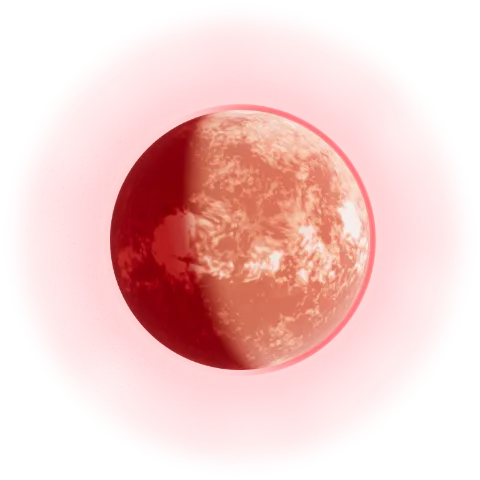
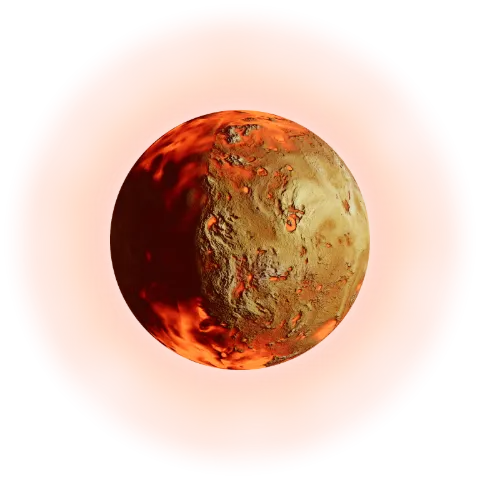
A small, scorched remnant that may have survived being swallowed when its star swelled into a red giant. It would race around the star’s exposed core every 5.8 hours at nearly 7,800 K. NASA lists it as controversial: the signal may be the star’s own pulsations.
- Radius
- 0.759 × Earth
- Temperature
- 7,778 K (7,505 °C)
- From Earth
- 4,015 light‑years
- History
- Swallowed by its star when it swelled into a red giant, and survived
- What is left
- A scorched core, smaller than Earth
- Temperature
- About 7,500 °C
- Sun
- A hot subdwarf, nearly 5 × hotter than the Sun’s surface
- One year
- 5.8 hours
At this heat any rock would melt or boil away, so the surface is shown as a lava sea under its huge blue-white sun. Whether the planet exists is debated: the signal may be the star itself pulsating. No one could survive here; you hover on a small platform.
Survivor Planet at a glance
- Status
- Controversial in NASA’s archive
- Radius
- 0.759 × Earth
- Mass
- 0.44 × Earth
- Year length
- 5.76 hours
- Temperature
- 7,778 K (7,505 °C)
- Host star
- Kepler-70 (hot subdwarf B star)
- From Earth
- 4,015 light-years
- Discovered
- 2011 · Orbital brightness modulation
- Data
- NASA Exoplanet Archive
Facts
- A planet that may have survived the impossible: being eaten alive.
- Its star is a hot subdwarf, burning several times hotter than the Sun.
- About 18 million years ago the star swelled into a red giant, and the planet plunged deep inside its layers, swallowed whole by a ball of plasma.
- The star stripped away all of its gas, but its burnt, rocky core survived.
- Even millions of years later, it is still estimated at around 6,600 °C (12,000 °F); NASA’s archive lists about 7,500 °C. Teleported there, you’d be vaporised faster than your brain could register arriving.
- Now smaller than Earth, it completes a year in under 6 hours.
History and research
Stéphane Charpinet’s team announced it and a sibling in Nature in December 2011. They were not seen crossing the star. Instead Kepler picked up two tiny, regular flickers in its light, which the team read as two planets reflecting and giving off heat as they went round.
In 2015 Jakub Krzesinski argued that the flickers could come from the star’s own pulsations, which are common in hot subdwarfs. The question is still open, which is why the planet is listed as disputed.
Sources: Wikipedia: Kepler-70. Checked 27 October 2026.
How big is Survivor Planet?
Survivor Planet is 9,671 km across: 2.78 times as wide as the Moon.
Questions about Survivor Planet
How far away is KOI-55 b?
4,015 light-years from Earth. Even at the speed of light, the trip would take 4,015 years.
How big is KOI-55 b?
Its radius is 0.759 times Earth’s, about 76% as wide as Earth.
How long is a year on KOI-55 b?
It goes once round its star in 5.76 hours. How old would you be there? →
How hot is KOI-55 b?
About 7,778 K (7,505 °C).
When was KOI-55 b discovered?
In 2011, by orbital brightness modulation.
More Exoplanets
All planetsHot PlanetsHottest PlanetKELT-9b · Ultra-hot JupiterRadius1.94 × JupiterTemperature3,921 K (3,648 °C) Hot PlanetsPulsing-Star PlanetWASP-33b · Ultra-hot JupiterRadius1.59 × JupiterTemperature2,782 K (2,509 °C) Hot PlanetsDoomed PlanetWASP-12b · Ultra-hot JupiterRadius1.97 × JupiterTemperature2,601 K (2,328 °C) Hot PlanetsGem-Rain PlanetWASP-121b · Ultra-hot JupiterRadius1.74 × JupiterTemperature2,409 K (2,136 °C) Hot PlanetsIron Rain WorldWASP-76 b · Ultra-hot JupiterRadius1.83 × JupiterTemperature2,160 K (1,887 °C) Hot PlanetsMirror PlanetLTT 9779 b · Ultra-hot NeptuneRadius4.72 × EarthTemperature1,978 K (1,705 °C) Hot PlanetsLava-Ocean World55 Cancri e (Janssen) · Super-Earth lava worldRadius1.88 × EarthTemperature1,958 K (1,685 °C) Hot PlanetsNaked CoreTOI-849 b · Exposed planetary coreRadius3.64 × EarthTemperature1,932 K (1,659 °C)