Cold Planets
Frozen Far World
OGLE-2005-BLG-390Lb · Cold super-Earth
One of the coldest planets known, around −220 °C, found when its star briefly magnified a more distant star’s light by gravitational microlensing. A rocky or icy super-Earth 21,500 light-years away, toward the centre of the galaxy.

- Radius
- 2.21 × Earth
- Temperature
- 50 K (-223 °C)
- From Earth
- 21,526 light‑years
- Temperature
- About −220 °C
- Snow
- Any air would freeze and fall as permanent snow
- Sun
- A dim red dwarf, too far to warm it
- Sky
- The crowded heart of the Milky Way, 21,500 light-years toward it
- Found by
- Its star briefly magnifying a more distant star’s light
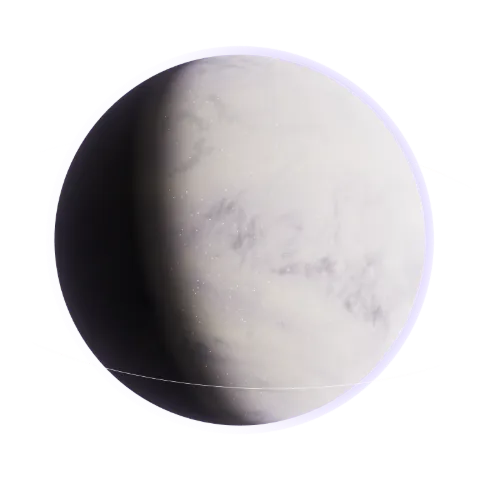
It isn’t quite pitch dark: the star gives a deep twilight, a few hundred times brighter than full moonlight. The frozen-air plains are an impression.
Frozen Far World at a glance
- Status
- Confirmed planet
- Radius
- 2.21 × Earth
- Mass
- 5.5 × Earth
- Year length
- 3,290 days
- Temperature
- 50 K (-223 °C)
- Host star
- OGLE-2005-BLG-390L (red dwarf)
- From Earth
- 21,526 light-years
- Discovered
- 2005 · Gravitational microlensing
- Data
- NASA Exoplanet Archive
Facts
- One of the coldest and emptiest planets ever found.
- It orbits a tiny, dim red dwarf from so far away that it gets almost no heat.
- Its surface drops to around −220 °C (−364 °F), where chemistry as we know it all but stops.
- Any atmosphere would have frozen solid and fallen to the ground as a layer of permanent snow.
- On its surface you would be surrounded by crushing silence and near-total darkness.
History and research
On 11 July 2005 the OGLE survey saw a distant star in Sagittarius brighten as a red dwarf passed in front of it and bent its light. Telescopes in the PLANET, RoboNet and MOA networks then followed it around the clock from Chile, Tasmania, South Africa and elsewhere.
On 10 August a small extra bump appeared, lasting about a day: the planet’s own gravity adding to the magnification. Jean-Philippe Beaulieu’s team announced it in January 2006. Such an alignment does not repeat, so the planet will never be seen again.
Sources: Wikipedia: OGLE-2005-BLG-390Lb. Checked 27 October 2026.
How big is Frozen Far World?
Frozen Far World is 28,160 km across: 2.21 times as wide as Earth.
Questions about Frozen Far World
How far away is OGLE-2005-BLG-390Lb?
21,526 light-years from Earth. Even at the speed of light, the trip would take 21,526 years.
How big is OGLE-2005-BLG-390Lb?
Its radius is 2.21 times Earth’s, about 2.2 times as wide as Earth.
How long is a year on OGLE-2005-BLG-390Lb?
It goes once round its star in 3,290 days. How old would you be there? →
How hot is OGLE-2005-BLG-390Lb?
About 50 K (-223 °C).
When was OGLE-2005-BLG-390Lb discovered?
In 2005, by gravitational microlensing: the way its gravity briefly magnified the light of a star behind it.
More Exoplanets
All planetsCold PlanetsFamily PortraitHR 8799 b · Young gas giantTemperature900 K (627 °C)From Earth133 light‑years Cold PlanetsSuper SaturnJ1407b · Ringed companionFrom Earth434 light‑years Cold PlanetsMethuselahPSR B1620-26 b · Ancient giant planetRadius1.19 × JupiterFrom Earth5,600 light‑years Strange PlanetsThree-Sun WorldHD 188753 Ab · Hot Jupiter (unconfirmed)From Earth150 light‑yearsYear length3.35 days Strange PlanetsDead-Star PlanetsPSR B1257+12 · Planets orbiting a dead starFrom Earth1,957 light‑years Strange PlanetsBackwards PlanetWASP-17b · Puffy hot JupiterRadius1.87 × JupiterTemperature1,755 K (1,482 °C) Strange PlanetsBurning Ice WorldGliese 436 b · Warm NeptuneRadius4.17 × EarthTemperature686 K (413 °C) Strange PlanetsThe Vanishing PlanetFomalhaut b (Dagon) · Former planet: a dust cloudFrom Earth25.0 light‑years