Planets
Venus
Terrestrial planet
Wrapped in sulfuric-acid clouds over a crushing CO₂ atmosphere, Venus is the hottest planet. It spins backwards, and so slowly that its day outlasts its year.
- Radius
- 6,052 km
- Orbital period
- 224.70 days
- Rotation period
- 243.0 days (retrograde)

On the surface · Rendered in Blender
Surface of Venus
Standing on the volcanic plains
- Temperature
- 464 °C, hot enough to melt lead
- Pressure
- 92 × Earth’s, like 900 m under the sea
- Sky
- Sulfuric-acid clouds 45–70 km up hide the Sun
- Light
- Dim and orange, like a very overcast evening
- One day
- 117 Earth days from sunrise to sunrise
Based on colour photos from the Soviet Venera 13 and 14 landers (1982) and Magellan radar maps. No one could really stand here: Venera 13, the longest-lived lander, survived 127 minutes. The lava rivers and eruption are an artist’s impression of Venus’s ongoing volcanism.
Venus at a glance
- Radius
- 6,052 km
- From the Sun now
- 0.724 AU · 6.0 light-min
- Orbital period
- 224.70 days
- Rotation period
- 243.0 days (retrograde)
- Axial tilt
- 177.36°
Facts
- The hottest planet, at about 465 °C, hot enough to melt lead, even though Mercury is closer to the Sun.
- Standing on the surface would feel like being 900 m under the sea: the air is about 90 times thicker than Earth’s.
- A day on Venus is longer than its year, and it spins backwards, so the Sun rises in the west.
- Its clouds are made of sulfuric acid, and the wind up there circles the whole planet in four days, 60 times faster than the ground turns.
- The Soviet Venera 13 lander survived on the surface for 127 minutes in 1982 and sent back the first colour photos.
- It is almost exactly Earth’s size, and may once have had oceans before a runaway greenhouse boiled them away.
History and research
In 1761 and 1769 expeditions spread around the world to time Venus crossing the face of the Sun, as a way to measure how far away the Sun is. James Cook’s first voyage, to Tahiti, was one of them. During the 1761 crossing Mikhail Lomonosov saw a thin ring of light around the planet’s edge and concluded that Venus has an atmosphere.
Mariner 2 flew past in 1962, the first successful visit to another planet, and measured a surface far hotter than expected. The Soviet Venera 7 landed in 1970 and sent back signals for about 23 minutes, the first data from the surface of another planet. NASA’s Magellan then mapped 98% of Venus by radar between 1990 and 1994, finding volcanoes, lava plains and very few craters. ESA’s EnVision is planned to launch in the early 2030s to map it again in finer detail.
Sources: NASA: Venus, Wikipedia: Transit of Venus, Wikipedia: Magellan (spacecraft). Checked 27 October 2026.
How big is Venus?
Venus is 12,104 km across: 3.48 times as wide as the Moon.
Images from NASA
Questions about Venus
How big is Venus?
Venus has a radius of 6,052 km, so it is 12,104 km across: about 95% as wide as Earth.
How far is Venus from the Sun?
On average 0.723 AU, or 108 million km. Right now it is 0.724 AU from the Sun: sunlight takes 6.0 minutes to get there.
How long is a day on Venus?
Venus spins once on its axis every 243.0 days, measured against the stars. It spins backwards compared with most planets.
How long is a year on Venus?
Venus takes 224.70 days to go once round the Sun. How old would you be there? →
What would I weigh on Venus?
Gravity at the surface is 8.87 m/s², 90% of Earth’s. Scales that read 50 kg on Earth would read about 45.2 kg on Venus. Work out your own weight there →
Can you see Venus from Earth?
Yes: after the Sun and the Moon it is the brightest thing in the sky, often called the evening or morning star. It is never far from the Sun, so look in the west after sunset or the east before sunrise. When it’s up in your sky tonight →
More Solar System
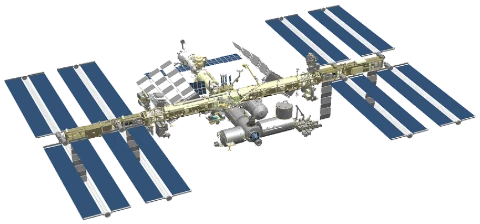
All worldsPlanetsEarthTerrestrial planetRadius6,371 kmOrbital period365.26 days MoonsMoonNatural satelliteRadius1,737 kmOrbital period27.32 days around Earth SpacecraftISSInternational Space StationSize109 m across · about a football pitchAbove Earth≈ 420 km PlanetsMarsTerrestrial planetRadius3,390 kmOrbital period686.98 days MoonsPhobosMoon of MarsRadius11 kmSize27 × 22 × 18 km Comets and asteroidsBennuNear-Earth asteroidRadius0 kmSizeabout 490 m across Comets and asteroidsVestaAsteroid · Asteroid beltRadius263 kmOrbital period3.63 years Dwarf planetsCeresDwarf planet · Asteroid beltRadius470 kmOrbital period4.60 years