Moons
Moon
Natural satellite
Earth’s only natural satellite, probably formed from debris of a giant impact. Tidally locked, it always shows us the same face and slowly drifts away by 3.8 cm a year.
- Radius
- 1,737 km
- Orbital period
- 27.32 days around Earth
- Rotation period
- 27.3 days · tidally locked
Moon at a glance
- Radius
- 1,737 km
- From the Sun now
- 0.994 AU · 8.3 light-min
- From Earth
- 384,400 km
- Orbital period
- 27.32 days around Earth
- Rotation period
- 27.3 days · tidally locked
- Axial tilt
- 6.68°
Facts
- Twelve people have walked on it, all between 1969 and 1972, on six Apollo missions.
- With no wind or rain to wipe them away, the astronauts’ footprints could last for millions of years.
- Seen from Earth it looks almost exactly as big as the Sun: the Sun is about 400 times wider, but also about 400 times farther away. That is why total eclipses of the Sun are possible.
- The dark patches, the maria or “seas”, are plains of hardened lava, not water, and are almost all on the side facing Earth.
- Its pull raises the tides. When the Sun lines up with it, at new and full Moon, the tides are highest.
- At just over a quarter of Earth’s width, it is huge for a moon compared with its planet. No other planet has a moon anywhere near as large in proportion.
History and research
Galileo’s drawings from 1609 and 1610 showed mountains and craters, lit from the side near the line between day and night, and made the Moon a place with landscape of its own. Nobody saw its far side until 1959, when the Soviet Luna 3 photographed it. The same year Luna 2 became the first spacecraft to reach it, by crashing into it.
The Apollo crews brought back 382 kg of rock and soil. The samples support the leading idea of how the Moon formed: from debris thrown out when a body about the size of Mars hit the young Earth. In 2019 China’s Chang’e 4 made the first landing on the far side, and in 2024 Chang’e 6 brought back the first samples from it. India’s Chandrayaan-3 landed near the south pole in August 2023.
Sources: NASA: Earth’s Moon, Wikipedia: Giant-impact hypothesis, Wikipedia: Chang%27e 6. Checked 27 October 2026.
How big is Moon?
Moon is 3,475 km across: Earth is 3.67 times as wide.
Images from NASA
Questions about Moon
How big is the Moon?
The Moon has a radius of 1,737 km, so it is 3,475 km across: about 27% as wide as Earth.
How far is the Moon from Earth?
On average 384,400 km from Earth’s centre. That is about 30 Earths lined up, and light covers it in 1.3 seconds.
How long is a day on the Moon?
The Moon spins once on its axis every 27.3 days, measured against the stars. It is tidally locked: the same side always faces Earth.
How long does the Moon take to orbit?
27.32 days around Earth.
What would I weigh on the Moon?
Gravity at the surface is 1.62 m/s², 17% of Earth’s. Scales that read 50 kg on Earth would read about 8.26 kg on the Moon. Work out your own weight there →
Can you see the Moon from Earth?
Yes: it is the brightest thing in the night sky, and binoculars show its craters and dark plains. When it’s up in your sky tonight →
More Solar System
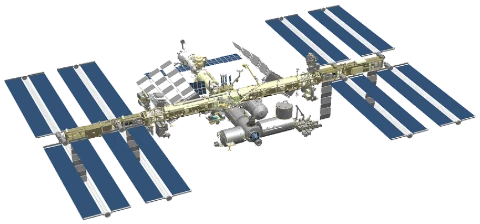
All worldsSpacecraftISSInternational Space StationSize109 m across · about a football pitchAbove Earth≈ 420 km PlanetsMarsTerrestrial planetRadius3,390 kmOrbital period686.98 days MoonsPhobosMoon of MarsRadius11 kmSize27 × 22 × 18 km Comets and asteroidsBennuNear-Earth asteroidRadius0 kmSizeabout 490 m across Comets and asteroidsVestaAsteroid · Asteroid beltRadius263 kmOrbital period3.63 years Dwarf planetsCeresDwarf planet · Asteroid beltRadius470 kmOrbital period4.60 years PlanetsJupiterGas giantRadius69,911 kmOrbital period11.86 years MoonsIoGalilean moonRadius1,822 kmOrbital period1.77 days around Jupiter