The Sun
Sun
G-type main-sequence star
A 4.6-billion-year-old ball of hydrogen and helium holding 99.8% of the solar system’s mass. Fusion in its core lights every world on this list.
- Radius
- 695,700 km
- Orbital period
- ≈ 230 million years (galactic)
- Rotation period
- 25.4 days
Sun at a glance
- Radius
- 695,700 km
- Orbital period
- ≈ 230 million years (galactic)
- Rotation period
- 25.4 days
- Axial tilt
- 7.25°
Facts
- Its light takes about 8 minutes 20 seconds to reach Earth, but the energy behind it spent tens of thousands of years or more working its way out from the core.
- Every second, its core turns about 600 million tonnes of hydrogen into helium; some 4 million tonnes of that vanishes, turned into pure energy.
- The visible surface is about 5,500 °C, yet the thin outer atmosphere, the corona, is over a million degrees. Why it is so much hotter is still not fully understood.
- Its magnetic activity rises and falls over about 11 years: at the peak, sunspots, flares and northern lights are most common.
- Its wind blows a bubble in interstellar space, the heliosphere, reaching far beyond Pluto. Voyager 1 crossed its edge in 2012.
- In about 5 billion years it will run out of hydrogen in its core, swell into a red giant, and then shrink into a white dwarf about the size of Earth.
History and research
Galileo and his contemporaries sketched sunspots through the first telescopes in 1610 to 1612 and watched them drift across the disk, which showed that the Sun turns. In 1843 Heinrich Schwabe, a German pharmacist who had been hunting for a planet inside Mercury’s orbit, noticed that the number of spots rose and fell over about ten years. In 1859 Richard Carrington saw a flare in white light, and the next day a magnetic storm lit up aurorae as far south as the Caribbean and set telegraph lines sparking.
Parker Solar Probe, launched in 2018, has flown through the Sun’s outer atmosphere. On 24 December 2024 it passed 6.1 million km from the surface at about 690,000 km/h, closer and faster than any spacecraft before it. ESA’s Solar Orbiter has been tilting its orbit out of the plane of the planets, and in 2025 it sent back the first pictures of the Sun’s poles.
Sources: NASA: The Sun, NASA: Parker Solar Probe, Wikipedia: Carrington Event. Checked 27 October 2026.
How big is Sun?
Sun is 1.39 million km across: 9.95 times as wide as Jupiter.
Images from NASA
Questions about Sun
How big is the Sun?
The Sun has a radius of 695,700 km, so it is 1,391,400 km across: about 109 times as wide as Earth.
What would I weigh on the Sun?
At its glowing surface (it is all gas, with nothing to stand on), gravity is 274 m/s², 27.9 times Earth’s. Scales that read 50 kg on Earth would read about 1,400 kg on the Sun. Work out your own weight there →
More Solar System
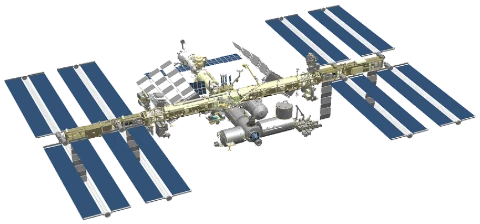
All worldsPlanetsMercuryTerrestrial planetRadius2,440 kmOrbital period87.97 days PlanetsVenusTerrestrial planetRadius6,052 kmOrbital period224.70 days PlanetsEarthTerrestrial planetRadius6,371 kmOrbital period365.26 days MoonsMoonNatural satelliteRadius1,737 kmOrbital period27.32 days around Earth SpacecraftISSInternational Space StationSize109 m across · about a football pitchAbove Earth≈ 420 km PlanetsMarsTerrestrial planetRadius3,390 kmOrbital period686.98 days MoonsPhobosMoon of MarsRadius11 kmSize27 × 22 × 18 km Comets and asteroidsBennuNear-Earth asteroidRadius0 kmSizeabout 490 m across