Spacecraft
ISS
International Space Station
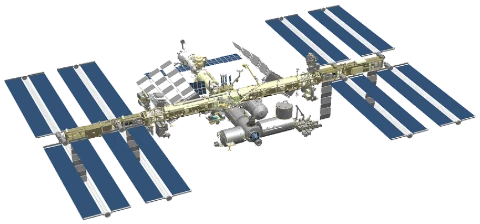
A laboratory the size of a football pitch, circling Earth every hour and a half about 420 km up. Five space agencies built it from 1998, and people have lived aboard without a break since November 2000. Drawn here about 1,500 times larger than life so you can find it; its exact place on the orbit is illustrative.
- Size
- 109 m across · about a football pitch
- Above Earth
- ≈ 420 km
- Speed
- 7.66 km/s · 27,600 km/h
ISS at a glance
- Size
- 109 m across · about a football pitch
- Above Earth
- ≈ 420 km
- Speed
- 7.66 km/s · 27,600 km/h
- One orbit
- 92.9 minutes · 15.5 a day
- Orbit tilt
- 51.6° to the equator
- Mass
- ≈ 420 tonnes
- Crew
- Usually 7
- Lived in since
- 2 November 2000
Facts
- It travels at about 28,000 km/h, fast enough to cross the Atlantic in around 12 minutes.
- The crew see about 16 sunrises and 16 sunsets every day. Watch it here slip into Earth’s shadow and go dark.
- Gravity up there is still about 90% as strong as on the ground. The crew float because they are falling around Earth all the time, and always missing it.
- Its eight big solar wings turn to follow the Sun, as they do here. Together they cover about 2,500 m².
- Thin air still drags on it, so it slowly sinks. Visiting spacecraft fire their engines now and then to push it back up.
- You can see it without a telescope: after dusk or before dawn it crosses the sky in a few minutes, brighter than any star.
- It is due to be retired around 2030 and steered down into a remote part of the Pacific Ocean.
History and research
Its first part, the Russian Zarya module, was launched in November 1998, and the American Unity node was attached two weeks later. Crews have lived on board without a break since 2 November 2000. Five space agencies run it: NASA, Roscosmos, ESA, JAXA and the Canadian Space Agency.
Much of its research is on what weightlessness does to people. Scott Kelly spent 340 days aboard in 2015 and 2016 while his identical twin, Mark, stayed on the ground, which gave NASA a rare side-by-side comparison of the body in space and on Earth. Its Cold Atom Lab has chilled atoms to less than a millionth of a degree above absolute zero, colder than is practical in a laboratory on the ground.
Sources: NASA: International Space Station, Wikipedia: International Space Station, Wikipedia: NASA Twins Study. Checked 27 October 2026.
Images from NASA
Questions about ISS
How high is the ISS?
It orbits about 420 km above Earth, about the distance from London to Paris, but straight up.
How fast does the ISS go?
7.66 km/s, or 27,600 km/h. It goes round Earth about every 93 minutes, so its crew sees 16 sunrises a day.
How many people live on the ISS?
Usually 7, in a home about as roomy as a six-bedroom house. People have lived on board without a break since November 2000.
Can you see the ISS from Earth?
Yes: it looks like a very bright, steady star gliding across the sky in a few minutes, no blinking lights. It can be seen shortly after sunset or before sunrise, when it passes overhead in sunlight while the ground is dark.
More Solar System
All worldsPlanetsMarsTerrestrial planetRadius3,390 kmOrbital period686.98 days MoonsPhobosMoon of MarsRadius11 kmSize27 × 22 × 18 km Comets and asteroidsBennuNear-Earth asteroidRadius0 kmSizeabout 490 m across Comets and asteroidsVestaAsteroid · Asteroid beltRadius263 kmOrbital period3.63 years Dwarf planetsCeresDwarf planet · Asteroid beltRadius470 kmOrbital period4.60 years PlanetsJupiterGas giantRadius69,911 kmOrbital period11.86 years MoonsIoGalilean moonRadius1,822 kmOrbital period1.77 days around Jupiter MoonsEuropaGalilean moonRadius1,561 kmOrbital period3.55 days around Jupiter