Planets
Mercury
Terrestrial planet
The smallest planet and the closest to the Sun. With almost no atmosphere, its cratered surface swings from 430 °C by day to −180 °C at night.
- Radius
- 2,440 km
- Orbital period
- 87.97 days
- Rotation period
- 58.7 days

On the surface · Rendered in Blender
Surface of Mercury
Standing on a cratered plain
- Sun
- Up to 3 × wider than from Earth
- Temperature
- 430 °C by day, −180 °C at night
- Air
- Almost none: a black sky full of stars
- One day
- 176 Earth days from sunrise to sunrise
Based on MESSENGER’s images. Venus shines as the brightest point in the sky.
Mercury at a glance
- Radius
- 2,440 km
- From the Sun now
- 0.355 AU · 3.0 light-min
- Orbital period
- 87.97 days
- Rotation period
- 58.7 days
- Axial tilt
- 0.03°
Facts
- A day on Mercury, from one sunrise to the next, lasts 176 Earth days: two of its years.
- In some places the Sun rises, stops, slips back down and rises again, because Mercury’s orbit speeds up so much near the Sun.
- Days reach 430 °C, nights fall to −180 °C: the biggest swing of any planet, with no air to hold the heat.
- Even so close to the Sun, there is water ice hiding in craters at its poles that never see sunlight.
- Its iron core fills about 85% of its width, so it is like a cannonball with a thin rocky skin.
- It is shrinking: as the core cools, the whole planet contracts, wrinkling the surface into cliffs hundreds of kilometres long.
History and research
Mercury never strays more than about 28° from the Sun in our sky, so it can only be seen low in the twilight, and for centuries little could be learned about it. Astronomers long believed it kept one face to the Sun. Radar echoes bounced off it in 1965 showed instead that it turns three times for every two orbits.
Mariner 10 flew past three times in 1974 and 1975 and photographed under half of the surface. MESSENGER orbited it from 2011 to 2015 and mapped all of it. It also found more sulfur and potassium on the surface than expected; both boil away easily, which was a surprise on a planet so close to the Sun. When its fuel ran out, it crashed into the surface. BepiColombo, built by ESA and Japan and launched in 2018, is due to go into orbit around Mercury in late 2026.
Sources: NASA: Mercury, Wikipedia: MESSENGER, Wikipedia: BepiColombo. Checked 27 October 2026.
How big is Mercury?
Mercury is 4,879 km across: 1.4 times as wide as the Moon.
Images from NASA
Questions about Mercury
How big is Mercury?
Mercury has a radius of 2,440 km, so it is 4,879 km across: about 38% as wide as Earth.
How far is Mercury from the Sun?
On average 0.387 AU, or 57.9 million km. Right now it is 0.355 AU from the Sun: sunlight takes 3.0 minutes to get there.
How long is a day on Mercury?
Mercury spins once on its axis every 58.7 days, measured against the stars.
How long is a year on Mercury?
Mercury takes 87.97 days to go once round the Sun. How old would you be there? →
What would I weigh on Mercury?
Gravity at the surface is 3.7 m/s², 38% of Earth’s. Scales that read 50 kg on Earth would read about 18.9 kg on Mercury. Work out your own weight there →
Can you see Mercury from Earth?
Yes, with the naked eye, but only for a few weeks at a time, low in the twilight just after sunset or before sunrise: it never strays far from the Sun. When it’s up in your sky tonight →
More Solar System
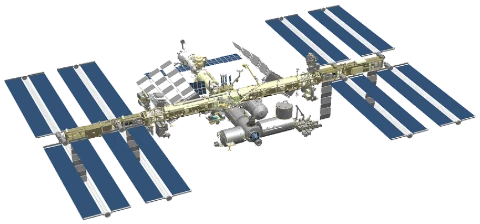
All worldsPlanetsVenusTerrestrial planetRadius6,052 kmOrbital period224.70 days PlanetsEarthTerrestrial planetRadius6,371 kmOrbital period365.26 days MoonsMoonNatural satelliteRadius1,737 kmOrbital period27.32 days around Earth SpacecraftISSInternational Space StationSize109 m across · about a football pitchAbove Earth≈ 420 km PlanetsMarsTerrestrial planetRadius3,390 kmOrbital period686.98 days MoonsPhobosMoon of MarsRadius11 kmSize27 × 22 × 18 km Comets and asteroidsBennuNear-Earth asteroidRadius0 kmSizeabout 490 m across Comets and asteroidsVestaAsteroid · Asteroid beltRadius263 kmOrbital period3.63 years