Planets
Earth
Terrestrial planet
Our home, and the only world known to support life. Oceans cover about 71% of its surface. Night-side city lights, clouds and seasons are shown for the date above.
- Radius
- 6,371 km
- Orbital period
- 365.26 days
- Rotation period
- 23 h 56 m
- Oceans
- Cover about 71% of the surface
- Air
- 78% nitrogen, 21% oxygen
- Life
- The only place it is known to exist
- Moon
- Up in the daytime sky
Home, drawn in the same style as the other worlds.
Earth at a glance
- Radius
- 6,371 km
- From the Sun now
- 0.994 AU · 8.3 light-min
- Orbital period
- 365.26 days
- Rotation period
- 23 h 56 m
- Axial tilt
- 23.44°
Facts
- The only place in the universe where life is known to exist.
- Earth is not perfectly round: the spin makes it bulge, so the top of Chimborazo in Ecuador is the point farthest from Earth’s centre, not Everest.
- Its days are slowly getting longer, as the Moon’s tides act like a brake. When the dinosaurs lived, a day was about 23 hours.
- More than 70% of the surface is ocean, and most of the ocean floor has never been mapped in detail.
- The magnetic field shields us from the solar wind; where the wind leaks in near the poles, it lights up the aurorae.
- You are moving at about 107,000 km/h around the Sun right now.
History and research
Around 240 BC Eratosthenes worked out the size of the Earth from a single difference: at noon on midsummer’s day the Sun stood straight overhead at Syene, in southern Egypt, but cast a short shadow at Alexandria, to the north. From that angle and the distance between the cities he got the circumference. How close he came depends on which length of stadion he used, but his method was sound.
The Apollo 8 crew photographed Earthrise from lunar orbit in December 1968, and the Apollo 17 crew took the Blue Marble picture in 1972. In 1990 Voyager 1, about 6 billion km away, turned its camera back and caught Earth as a dot smaller than a pixel: the Pale Blue Dot. Landsat satellites have photographed the whole planet since 1972, the longest unbroken record of its surface from space.
Sources: NASA: Earth, Wikipedia: Eratosthenes, Wikipedia: Pale Blue Dot. Checked 27 October 2026.
How big is Earth?
Earth is 12,742 km across: 3.67 times as wide as the Moon.
Images from NASA
Questions about Earth
How big is Earth?
Earth has a radius of 6,371 km: it is 12,742 km across, and 40,075 km round the equator.
How far is Earth from the Sun?
On average 1 AU, or 150 million km. Right now it is 0.994 AU from the Sun: sunlight takes 8.3 minutes to get there.
How long is a day on Earth?
Earth spins once on its axis every 23 h 56 m, measured against the stars.
How long is a year on Earth?
Earth takes 365.26 days to go once round the Sun: the extra quarter day is why there is a leap year every four years. How old would you be there? →
More Solar System
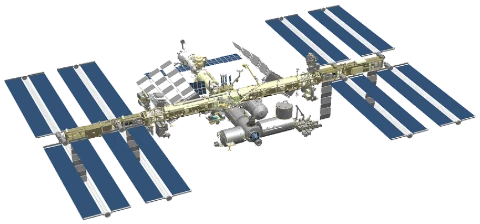
All worldsMoonsMoonNatural satelliteRadius1,737 kmOrbital period27.32 days around Earth SpacecraftISSInternational Space StationSize109 m across · about a football pitchAbove Earth≈ 420 km PlanetsMarsTerrestrial planetRadius3,390 kmOrbital period686.98 days MoonsPhobosMoon of MarsRadius11 kmSize27 × 22 × 18 km Comets and asteroidsBennuNear-Earth asteroidRadius0 kmSizeabout 490 m across Comets and asteroidsVestaAsteroid · Asteroid beltRadius263 kmOrbital period3.63 years Dwarf planetsCeresDwarf planet · Asteroid beltRadius470 kmOrbital period4.60 years PlanetsJupiterGas giantRadius69,911 kmOrbital period11.86 years