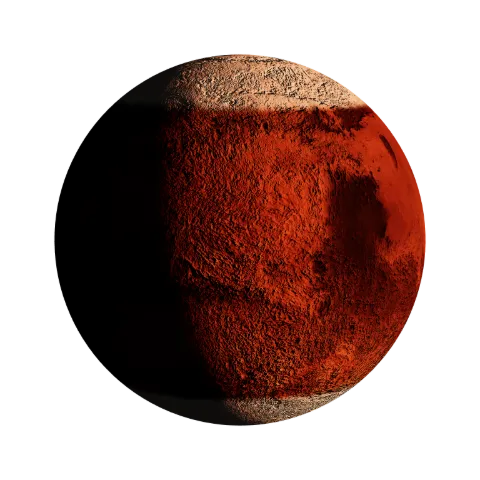
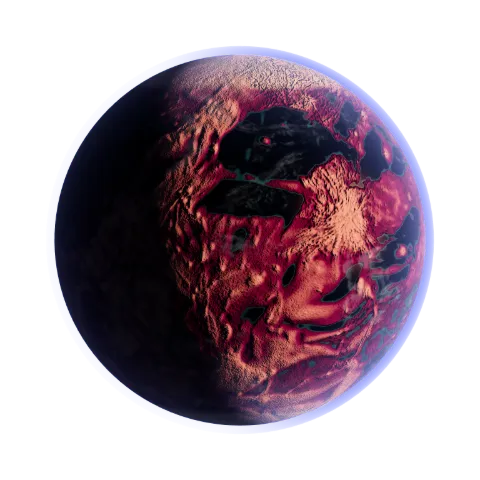
Exoplanets
Hazy Sub-Neptune
GJ 1214 b · Sub-Neptune
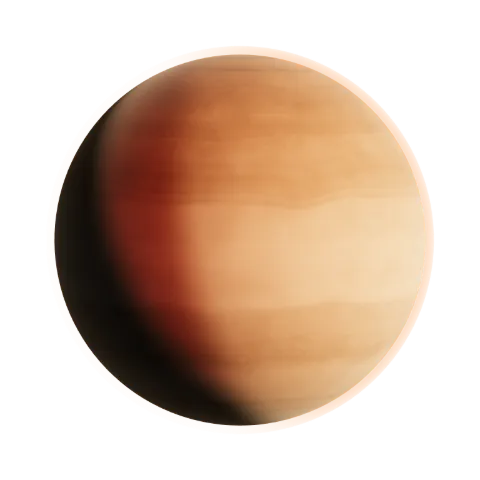
One of the most studied planets of a kind the Solar System lacks: between Earth and Neptune in size. Its sky is so hazy that for years telescopes could see nothing through it.
- Radius
- 2.74 × Earth
- Temperature
- 596 K (323 °C)
- From Earth
- 48.0 light‑years
Hazy Sub-Neptune at a glance
- Status
- Confirmed planet
- Radius
- 2.74 × Earth
- Mass
- 8.17 × Earth
- Year length
- 1.58 days
- Temperature
- 596 K (323 °C)
- Host star
- GJ 1214, a red dwarf
- From Earth
- 48.0 light-years
- Discovered
- 2009 · Transit
- Data
- Published studies
Facts
- It was found by the MEarth project, a set of small robotic telescopes in Arizona built to look for planets around red dwarfs.
- In 2023 Webb measured its heat and found a very reflective, hazy atmosphere, possibly rich in water vapour or methane.
- Sub-Neptunes are the most common size of planet found so far.
- Its star is only about a fifth of the Sun’s width, so the planet blocks over 1% of its light when it crosses: a deep dip that made it easy to study.
- Its density is less than half of Earth’s.
History and research
David Charbonneau’s team announced it in December 2009, about 48 light-years away in Ophiuchus. It was only the second super-Earth seen crossing its star, and since its star is small and close, astronomers hoped to read its atmosphere easily.
Instead the spectrum came back flat. A VLT study in 2010 found no features, and in 2014 Laura Kreidberg’s team watched 15 crossings with Hubble and still saw none: the air was hidden behind high clouds or haze. Webb finally got through in 2023 by mapping the planet’s heat over a whole orbit rather than looking through its edge.
Sources: Wikipedia: GJ 1214 b. Checked 27 October 2026.
How big is Hazy Sub-Neptune?
Hazy Sub-Neptune is 34,913 km across: 2.74 times as wide as Earth.
Questions about Hazy Sub-Neptune
How far away is GJ 1214 b?
48.0 light-years from Earth. Even at the speed of light, the trip would take 48.0 years.
How big is GJ 1214 b?
Its radius is 2.74 times Earth’s, about 2.7 times as wide as Earth.
How long is a year on GJ 1214 b?
It goes once round its star in 1.58 days. How old would you be there? →
How hot is GJ 1214 b?
About 596 K (323 °C).
What would I weigh on GJ 1214 b?
Gravity at the surface is 10.7 m/s², 1.09 times Earth’s. Scales that read 50 kg on Earth would read about 54.4 kg on GJ 1214 b. Work out your own weight there →
When was GJ 1214 b discovered?
In 2009, by the transit method: the slight dip in its star’s light each time the planet passes in front of it.
More Exoplanets
All planetsExoplanetsReal TatooineKepler-16 b · Circumbinary gas giantRadius0.754 × JupiterTemperature188 K (-85 °C) ExoplanetsHabitable-Zone PioneerKepler-22 b · Super-Earth or mini-NeptuneRadius2.1 × EarthTemperature262 K (-11 °C) ExoplanetsFirst Rocky WorldKepler-10 b · Rocky lava planetRadius1.47 × EarthTemperature2,169 K (1,896 °C) ExoplanetsWebb’s First PortraitHIP 65426 b · Young gas giantRadius1.5 × JupiterTemperature1,600 K (1,327 °C) ExoplanetsNewborn PlanetPDS 70 b · Forming giant planetTemperature1,200 K (927 °C)From Earth370 light‑years Earth-like ExoplanetsOur Nearest NeighbourProxima Centauri b · Rocky planetRadius1.02 × EarthTemperature218 K (-55 °C) Earth-like ExoplanetsEarth-Like NeighbourTeegarden’s Star b · Rocky planet, habitable zoneTemperature277 K (4 °C)From Earth12.5 light‑years Earth-like ExoplanetsNearby Venus-EarthGliese 12 b · Earth-sized planetRadius0.96 × EarthTemperature315 K (42 °C)