Exoplanets
First Imaged Planet
2M1207 b · Young giant planet
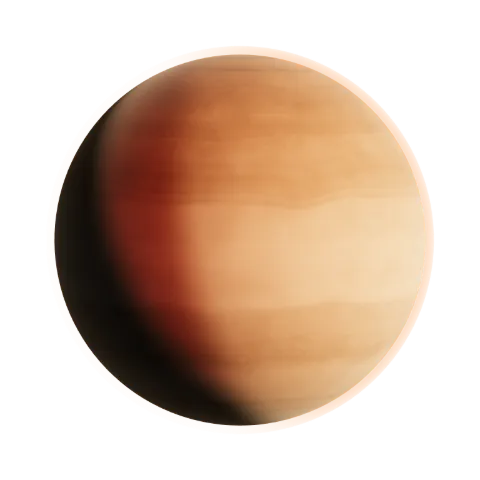
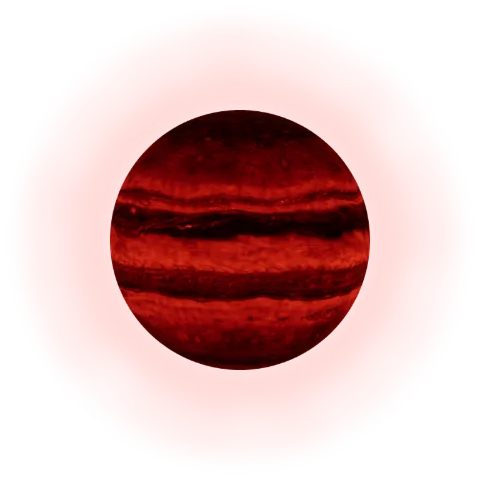
The first planet ever photographed directly (2004). It circles a brown dwarf, a failed star, at about 40 times the Earth–Sun distance, and still glows red from the heat of its formation.
- Temperature
- 1,250 K (977 °C)
- From Earth
- 170 light‑years
- Mass
- 5.03 × Jupiter
- First
- The first planet ever photographed directly (2004)
- Its sun
- A brown dwarf: a failed star, here a dim red spark
- Glow
- About 1,000 °C, heat left from its formation
- Distance
- About 40 × Earth’s from the Sun, from its brown dwarf
There is no ground to stand on here, so you hover on a small platform: no one could survive here, and the colours are educated guesses.
First Imaged Planet at a glance
- Status
- Confirmed planet
- Mass
- 5.03 × Jupiter
- Temperature
- 1,250 K (977 °C)
- Mass
- About 5 × Jupiter (uncertain)
- Host star
- 2M1207 A (brown dwarf)
- From Earth
- 170 light-years
- Discovered
- 2004 · Direct imaging
- Data
- Published studies
Facts
- The first planet ever photographed directly, in 2004.
- It circles a brown dwarf, a “failed star” too small to burn hydrogen.
- It still glows red from the heat of its formation.
- Its brown dwarf weighs about 25 Jupiters, so the pair is closer to a double than to a star with a planet.
History and research
Gaël Chauvin and his team spotted a faint red dot next to the brown dwarf 2M1207 in April 2004, with the adaptive optics of the Very Large Telescope in Chile. A dot near a star can easily be a background object, so they waited a year: in 2005 images from the VLT and Hubble showed the two moving across the sky together.
The pair belongs to the TW Hydrae association, a group of young stars about 170 light-years away and around 10 million years old. In 2016 Hubble watched the planet brighten and dim as clouds turned with it, and worked out that it spins about once every 10 hours.
Sources: Wikipedia: 2M1207b. Checked 27 October 2026.
How big is First Imaged Planet?
First Imaged Planet is 214,238 km across: 1.53 times as wide as Jupiter.
Illustrations from NASA
Questions about First Imaged Planet
How far away is 2M1207 b?
170 light-years from Earth. Even at the speed of light, the trip would take 170 years.
How hot is 2M1207 b?
About 1,250 K (977 °C).
When was 2M1207 b discovered?
In 2004, by direct imaging: photographing it as a faint dot beside its star.
More Exoplanets
All planetsExoplanetsHazy Sub-NeptuneGJ 1214 b · Sub-NeptuneRadius2.74 × EarthTemperature596 K (323 °C) ExoplanetsReal TatooineKepler-16 b · Circumbinary gas giantRadius0.754 × JupiterTemperature188 K (-85 °C) ExoplanetsHabitable-Zone PioneerKepler-22 b · Super-Earth or mini-NeptuneRadius2.1 × EarthTemperature262 K (-11 °C) ExoplanetsFirst Rocky WorldKepler-10 b · Rocky lava planetRadius1.47 × EarthTemperature2,169 K (1,896 °C) ExoplanetsWebb’s First PortraitHIP 65426 b · Young gas giantRadius1.5 × JupiterTemperature1,600 K (1,327 °C) ExoplanetsNewborn PlanetPDS 70 b · Forming giant planetTemperature1,200 K (927 °C)From Earth370 light‑years Earth-like ExoplanetsOur Nearest NeighbourProxima Centauri b · Rocky planetRadius1.02 × EarthTemperature218 K (-55 °C) Earth-like ExoplanetsEarth-Like NeighbourTeegarden’s Star b · Rocky planet, habitable zoneTemperature277 K (4 °C)From Earth12.5 light‑years