Exoplanets
Dimidium
51 Pegasi b · Hot Jupiter
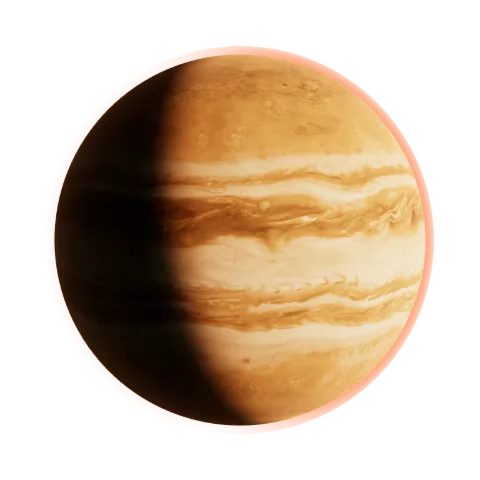
The first planet found around a Sun-like star (1995), which won its discoverers the Nobel Prize. Half as massive as Jupiter but circling its star every four days, it revealed a kind of planet nobody had expected: the hot Jupiter.
- Temperature
- 1,260 K (987 °C)
- From Earth
- 50.6 light‑years
- Mass
- 0.459 × Jupiter
- First
- The first planet found around a Sun-like star (1995)
- Prize
- Its discoverers won the 2019 Nobel Prize in Physics
- Surprise
- A giant on a 4-day orbit: nobody expected one
- Temperature
- About 1,000 °C
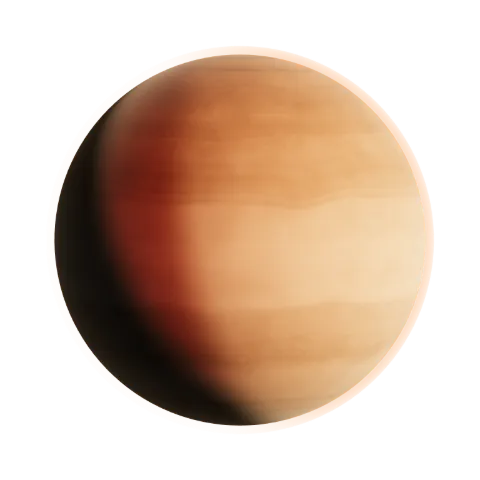
There is no ground to stand on here, so you hover on a small platform: no one could survive here, and the colours are educated guesses.
Dimidium at a glance
- Status
- Confirmed planet
- Mass
- 0.459 × Jupiter
- Year length
- 4.23 days
- Temperature
- 1,260 K (987 °C)
- Mass
- At least 0.46 × Jupiter (radial velocity gives a minimum)
- Host star
- 51 Pegasi (G2 IV, Sun-like)
- From Earth
- 50.6 light-years
- Discovered
- 1995 · Radial velocity
- Data
- Published studies
Facts
- The first planet found around a Sun-like star, in 1995.
- Its discoverers, Michel Mayor and Didier Queloz, won the 2019 Nobel Prize in Physics.
- A giant orbiting in just 4 days was so unexpected that it created a new class of planet: the hot Jupiter.
- Its star is about 50 light-years away and can just be seen with the naked eye under a dark sky.
- It is about 20 times closer to its star than Earth is to the Sun.
History and research
Michel Mayor and Didier Queloz found it with the ELODIE spectrograph at the Haute-Provence Observatory in southern France, and announced it on 6 October 1995 at a conference in Florence. Within a week Geoffrey Marcy and Paul Butler had confirmed the wobble from Lick Observatory in California. They then went back through their own data and found more planets they had not been looking for.
In 2015 a public vote named the planet Dimidium, Latin for “half”, after its mass of about half a Jupiter. Its star was named Helvetios, after the Celtic tribe of ancient Switzerland. In 2017 astronomers picked out water vapour in its atmosphere from the tiny shifts in its light.
Sources: Wikipedia: 51 Pegasi b, Wikipedia: Didier Queloz. Checked 27 October 2026.
How big is Dimidium?
Dimidium is 171,390 km across: 1.23 times as wide as Jupiter.
Illustrations from NASA
Questions about Dimidium
How far away is 51 Pegasi b?
50.6 light-years from Earth. Even at the speed of light, the trip would take 50.6 years.
How long is a year on 51 Pegasi b?
It goes once round its star in 4.23 days. How old would you be there? →
How hot is 51 Pegasi b?
About 1,260 K (987 °C).
When was 51 Pegasi b discovered?
In 1995, by the radial-velocity method: the slight wobble the planet’s pull gives its star.
More Exoplanets
All planetsExoplanetsOsirisHD 209458 b · Hot JupiterRadius1.36 × JupiterTemperature1,450 K (1,177 °C) ExoplanetsÆgirEpsilon Eridani b · Cold gas giantFrom Earth10.5 light‑yearsMass0.661 × Jupiter ExoplanetsFirst Imaged Planet2M1207 b · Young giant planetTemperature1,250 K (977 °C)From Earth170 light‑years ExoplanetsHazy Sub-NeptuneGJ 1214 b · Sub-NeptuneRadius2.74 × EarthTemperature596 K (323 °C) ExoplanetsReal TatooineKepler-16 b · Circumbinary gas giantRadius0.754 × JupiterTemperature188 K (-85 °C) ExoplanetsHabitable-Zone PioneerKepler-22 b · Super-Earth or mini-NeptuneRadius2.1 × EarthTemperature262 K (-11 °C) ExoplanetsFirst Rocky WorldKepler-10 b · Rocky lava planetRadius1.47 × EarthTemperature2,169 K (1,896 °C) ExoplanetsWebb’s First PortraitHIP 65426 b · Young gas giantRadius1.5 × JupiterTemperature1,600 K (1,327 °C)