Exoplanets
Osiris
HD 209458 b · Hot Jupiter
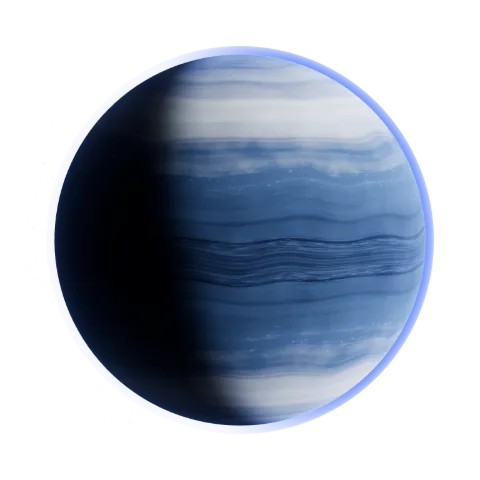
The first planet seen passing in front of its star (1999), and the first with a detected atmosphere. Its star is blasting that atmosphere away: hydrogen streams off it in a comet-like tail.
- Radius
- 1.36 × Jupiter
- Temperature
- 1,450 K (1,177 °C)
- From Earth
- 157 light‑years
- Firsts
- First planet seen crossing its star, and first with an atmosphere detected
- Evaporating
- Hydrogen streams off it in a comet-like tail
- Temperature
- About 1,200 °C
- One year
- 3.5 days
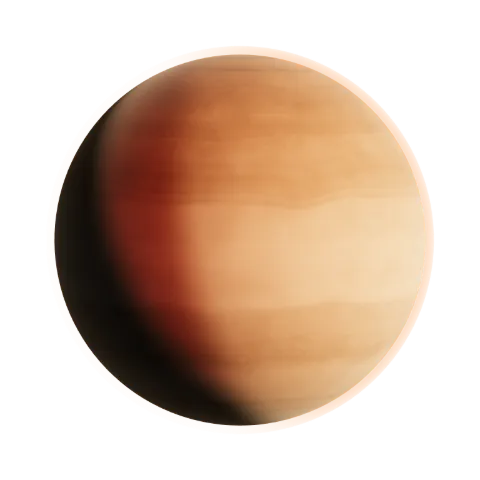
There is no ground to stand on here, so you hover on a small platform: no one could survive here, and the colours are educated guesses.
Osiris at a glance
- Status
- Confirmed planet
- Radius
- 1.36 × Jupiter
- Mass
- 0.686 × Jupiter
- Year length
- 3.52 days
- Temperature
- 1,450 K (1,177 °C)
- Host star
- HD 209458 (G0 V)
- From Earth
- 157 light-years
- Discovered
- 1999 · Transit
- Data
- Published studies
Facts
- The first planet seen passing in front of its star, in 1999.
- The first exoplanet with a detected atmosphere.
- Its star is boiling it away: hydrogen streams off it in a comet-like tail.
- It is larger than models of a planet of its mass predict, a puzzle it shares with many hot Jupiters.
- Its star is a near twin of the Sun, bright enough to see with binoculars.
History and research
In 1999 David Charbonneau, then a student, and Greg Henry independently watched the star dim as the planet crossed it, about 157 light-years away in Pegasus. Charbonneau used a small telescope with a 10 cm lens. For the first time, the size and density of a planet around another star could be worked out.
Two years later Charbonneau used Hubble to find sodium in its air. In 2005 Spitzer picked up the planet’s own infrared glow, and in 2010 Ignas Snellen’s team found carbon monoxide being blown from the day side to the night side at several thousand km/h. Its nickname is Osiris.
Sources: Wikipedia: HD 209458 b. Checked 27 October 2026.
How big is Osiris?
Osiris is 193,678 km across: 1.39 times as wide as Jupiter.
Illustrations from NASA
Questions about Osiris
How far away is HD 209458 b?
157 light-years from Earth. Even at the speed of light, the trip would take 157 years.
How big is HD 209458 b?
Its radius is 1.36 times Jupiter’s, about 15.2 times as wide as Earth.
How long is a year on HD 209458 b?
It goes once round its star in 3.52 days. How old would you be there? →
How hot is HD 209458 b?
About 1,450 K (1,177 °C).
What would I weigh on HD 209458 b?
At the cloud tops (there is no ground to stand on), gravity is 9.26 m/s², 94% of Earth’s. Scales that read 50 kg on Earth would read about 47.2 kg on HD 209458 b. Work out your own weight there →
When was HD 209458 b discovered?
In 1999, by the transit method: the slight dip in its star’s light each time the planet passes in front of it.
More Exoplanets
All planetsExoplanetsÆgirEpsilon Eridani b · Cold gas giantFrom Earth10.5 light‑yearsMass0.661 × Jupiter ExoplanetsFirst Imaged Planet2M1207 b · Young giant planetTemperature1,250 K (977 °C)From Earth170 light‑years ExoplanetsHazy Sub-NeptuneGJ 1214 b · Sub-NeptuneRadius2.74 × EarthTemperature596 K (323 °C) ExoplanetsReal TatooineKepler-16 b · Circumbinary gas giantRadius0.754 × JupiterTemperature188 K (-85 °C) ExoplanetsHabitable-Zone PioneerKepler-22 b · Super-Earth or mini-NeptuneRadius2.1 × EarthTemperature262 K (-11 °C) ExoplanetsFirst Rocky WorldKepler-10 b · Rocky lava planetRadius1.47 × EarthTemperature2,169 K (1,896 °C) ExoplanetsWebb’s First PortraitHIP 65426 b · Young gas giantRadius1.5 × JupiterTemperature1,600 K (1,327 °C) ExoplanetsNewborn PlanetPDS 70 b · Forming giant planetTemperature1,200 K (927 °C)From Earth370 light‑years