Earth-like Exoplanets
The Missed Twin
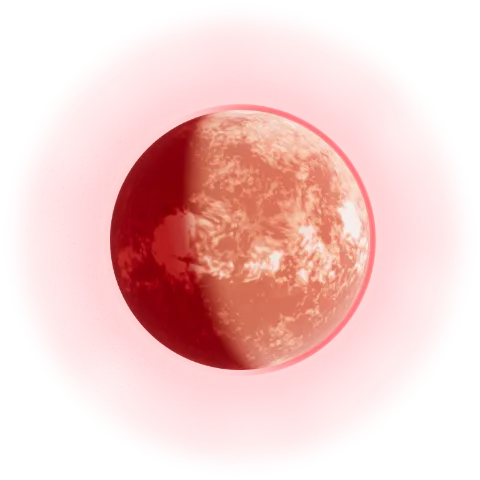
Kepler-1649 c · Earth-sized planet
A planet almost exactly Earth’s size that gets about three-quarters of the light Earth does, in its star’s habitable zone. A computer program had marked it as a false signal; people found it again in 2020.
- Radius
- 1.06 × Earth
- Temperature
- 234 K (-39 °C)
- From Earth
- 301 light‑years
The Missed Twin at a glance
- Status
- Confirmed planet
- Radius
- 1.06 × Earth
- Year length
- 19.5 days
- Temperature
- 234 K (-39 °C)
- Host star
- Kepler-1649, a red dwarf
- From Earth
- 301 light-years
- Discovered
- 2020 · Transit
- Data
- Published studies
Facts
- Scientists of the Kepler False Positive Working Group spotted it while rechecking signals the automatic search had thrown out.
- Its mass is unknown, so whether it is rocky is not certain, though at its size it most likely is.
- Another planet orbits closer in, roughly Earth-sized but much hotter.
- Its star has about a fifth of the Sun’s mass.
History and research
Andrew Vanderburg’s team announced it in April 2020, two years after Kepler had run out of fuel. Its star is a red dwarf about 300 light-years away in Cygnus.
Its orbit and that of the inner planet are close to a 9:4 rhythm, which is unusual. A third planet between them, not yet seen, would make the pattern a simpler chain like those in other systems.
Sources: Wikipedia: Kepler-1649c. Checked 27 October 2026.
How big is The Missed Twin?
The Missed Twin is 13,507 km across: 1.06 times as wide as Earth.
Questions about The Missed Twin
How far away is Kepler-1649 c?
301 light-years from Earth. Even at the speed of light, the trip would take 301 years.
How big is Kepler-1649 c?
Its radius is 1.06 times Earth’s, about 1.1 times as wide as Earth.
How long is a year on Kepler-1649 c?
It goes once round its star in 19.5 days. How old would you be there? →
How hot is Kepler-1649 c?
About 234 K (-39 °C).
When was Kepler-1649 c discovered?
In 2020, by the transit method: the slight dip in its star’s light each time the planet passes in front of it.
More Exoplanets
All planetsEarth-like ExoplanetsEarth’s CousinKepler-186 f · Rocky planet, habitable zoneRadius1.17 × EarthTemperature188 K (-85 °C) Earth-like ExoplanetsSuper-Earth HavenKepler-442 b · Super-Earth, habitable zoneRadius1.34 × EarthTemperature233 K (-40 °C) Earth-like ExoplanetsEarth 2.0Kepler-452 b · Super-Earth, habitable zoneRadius1.63 × EarthTemperature265 K (-8 °C) Hot PlanetsSurvivor PlanetKOI-55 b · Scorched planet candidateRadius0.759 × EarthTemperature7,778 K (7,505 °C) Hot PlanetsHottest PlanetKELT-9b · Ultra-hot JupiterRadius1.94 × JupiterTemperature3,921 K (3,648 °C) Hot PlanetsPulsing-Star PlanetWASP-33b · Ultra-hot JupiterRadius1.59 × JupiterTemperature2,782 K (2,509 °C) Hot PlanetsDoomed PlanetWASP-12b · Ultra-hot JupiterRadius1.97 × JupiterTemperature2,601 K (2,328 °C) Hot PlanetsGem-Rain PlanetWASP-121b · Ultra-hot JupiterRadius1.74 × JupiterTemperature2,409 K (2,136 °C)