Earth-like Exoplanets
Earth-Like Neighbour
Teegarden’s Star b · Rocky planet, habitable zone
At least as massive as Earth and lit by almost exactly as much light, around one of the closest red dwarfs to the Sun. By mass and warmth it scores among the most Earth-like planets known, but it has never been seen to transit, so its size is unknown.
- Temperature
- 277 K (4 °C)
- From Earth
- 12.5 light‑years
- Mass
- At least 1.05 × Earth (radial velocity gives a minimum)
- Warmth
- Lit by almost exactly as much light as Earth
- Distance
- 12.5 light-years
- Sun
- A small red dwarf, about 4 × wider in the sky than ours
- Sibling
- Teegarden’s Star c, a point of light in the sky
- One year
- 4.9 days
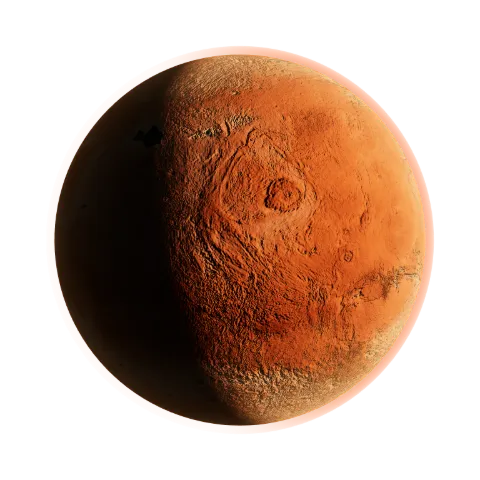
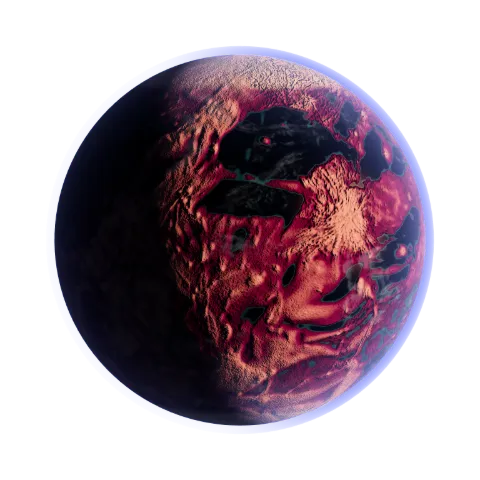
It has never been seen to cross its star, so even its size is unknown; this is an impression.
Earth-Like Neighbour at a glance
- Status
- Confirmed planet
- Year length
- 4.91 days
- Temperature
- 277 K (4 °C)
- Mass
- At least 1.05 × Earth (radial velocity gives a minimum)
- Host star
- Teegarden’s Star (M7 V red dwarf)
- From Earth
- 12.5 light-years
- Discovered
- 2019 · Radial velocity
- Data
- Published studies
Facts
- Lit by almost exactly as much light as Earth, around one of the closest red dwarfs to the Sun.
- By mass and warmth it ranks among the most Earth-like planets known.
- It has never been seen crossing its star, so nobody knows its size.
- Its star is so dim that the planet has to orbit about 40 times closer than Earth is to the Sun to get as much light.
- Its star has only about a tenth of the Sun’s mass and is far too faint to see without a telescope.
History and research
Its star was discovered only in 2003, despite being among the closest. Bonnard Teegarden at NASA found it in old data from a search for near-Earth asteroids, because it moves fast across the sky. It is so dim that earlier surveys had missed it.
The CARMENES spectrograph in Spain found planets b and c in 2019, from tiny wobbles in the star’s light. A third, planet d, was reported in 2024. The star is about 12.5 light-years away in Aries.
Sources: Wikipedia: Teegarden%27s Star b, Wikipedia: Teegarden%27s Star. Checked 27 October 2026.
How big is Earth-Like Neighbour?
Earth-Like Neighbour is 12,997 km across: 3.74 times as wide as the Moon.
Questions about Earth-Like Neighbour
How far away is Teegarden’s Star b?
12.5 light-years from Earth. Even at the speed of light, the trip would take 12.5 years.
How long is a year on Teegarden’s Star b?
It goes once round its star in 4.91 days. How old would you be there? →
How hot is Teegarden’s Star b?
About 277 K (4 °C).
When was Teegarden’s Star b discovered?
In 2019, by the radial-velocity method: the slight wobble the planet’s pull gives its star.
More Exoplanets
All planetsEarth-like ExoplanetsNearby Venus-EarthGliese 12 b · Earth-sized planetRadius0.96 × EarthTemperature315 K (42 °C) Earth-like ExoplanetsInner-Edge WorldTRAPPIST-1 d · Rocky planet, inner habitable zoneRadius0.788 × EarthTemperature288 K (15 °C) Earth-like ExoplanetsOcean CandidateTRAPPIST-1 e · Rocky planet, habitable zoneRadius0.92 × EarthTemperature251 K (-22 °C) Earth-like ExoplanetsFrozen-Sea WorldTRAPPIST-1 f · Rocky planet, habitable zoneRadius1.05 × EarthTemperature219 K (-54 °C) Earth-like ExoplanetsOuter Ice WorldTRAPPIST-1 g · Rocky planet, outer habitable zoneRadius1.13 × EarthTemperature198 K (-75 °C) Earth-like ExoplanetsEyeball Ocean WorldLHS 1140 b · Water world candidateRadius1.73 × EarthTemperature226 K (-47 °C) Earth-like ExoplanetsTESS’s EarthTOI-700 d · Rocky planet, habitable zoneRadius1.07 × EarthTemperature269 K (-4 °C) Earth-like ExoplanetsHycean WorldK2-18 b · Sub-Neptune, habitable zoneRadius2.61 × EarthTemperature255 K (-18 °C)