Earth-like Exoplanets
Inner-Edge World
TRAPPIST-1 d · Rocky planet, inner habitable zone
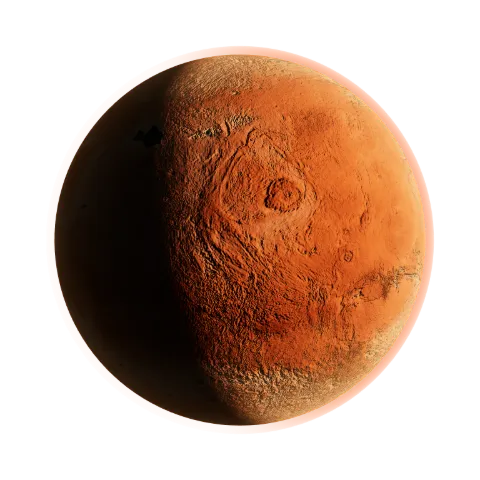
The innermost of TRAPPIST-1’s habitable-zone worlds, a little smaller than Earth. It gets about as much light as Venus does, so any water sits on a knife edge between oceans and steam. Seven Earth-sized planets circle this tiny red star, all closer to it than Mercury is to the Sun.
- Radius
- 0.788 × Earth
- Temperature
- 288 K (15 °C)
- From Earth
- 40.7 light‑years
- Light
- About as much as Venus gets from the Sun
- Water
- On a knife edge between seas and steam
- Sun
- An ultracool red dwarf, over 5 × wider in the sky than ours
- Neighbours
- Other TRAPPIST-1 planets, as discs in the sky
- One year
- 4 days
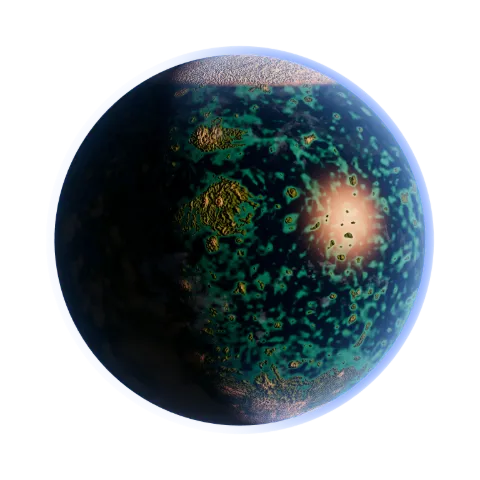
Whether it has air or water at all is unknown; this imagines a warm, steamy sea.
Inner-Edge World at a glance
- Status
- Confirmed planet
- Radius
- 0.788 × Earth
- Mass
- 0.388 × Earth
- Year length
- 4.05 days
- Temperature
- 288 K (15 °C)
- Host star
- TRAPPIST-1 (M8 V ultracool dwarf)
- From Earth
- 40.7 light-years
- Discovered
- 2016 · Transit
- Data
- Published studies
Facts
- TRAPPIST-1 has seven Earth-sized planets, all closer to their star than Mercury is to the Sun.
- They are so close together that from one, the others can look bigger than our Moon does.
- TRAPPIST-1 d gets about as much light as Venus does, so any water could be on the edge of boiling away.
- From its surface the star would look about five times as wide as the Sun does from Earth, but glow a dim red.
- Its surface gravity is about two-thirds of Earth’s.
History and research
In 2016 the TRAPPIST telescope found two planets around the star and an unclear third signal. Spitzer’s observations in 2017 showed that the signal came from several planets, and the name d went to one with a year of about four days.
Webb watched it cross its star in 2024 and published in 2025: there was no sign of an Earth-like air of water, methane or carbon dioxide. It may have a thin atmosphere or none at all.
Sources: Wikipedia: TRAPPIST-1d, Wikipedia: TRAPPIST-1. Checked 27 October 2026.
How big is Inner-Edge World?
Inner-Edge World is 10,041 km across: 2.89 times as wide as the Moon.
Illustrations from NASA
Questions about Inner-Edge World
How far away is TRAPPIST-1 d?
40.7 light-years from Earth. Even at the speed of light, the trip would take 40.7 years.
How big is TRAPPIST-1 d?
Its radius is 0.788 times Earth’s, about 79% as wide as Earth.
How long is a year on TRAPPIST-1 d?
It goes once round its star in 4.05 days. How old would you be there? →
How hot is TRAPPIST-1 d?
About 288 K (15 °C).
What would I weigh on TRAPPIST-1 d?
Gravity at the surface is 6.13 m/s², 62% of Earth’s. Scales that read 50 kg on Earth would read about 31.2 kg on TRAPPIST-1 d. Work out your own weight there →
When was TRAPPIST-1 d discovered?
In 2016, by the transit method: the slight dip in its star’s light each time the planet passes in front of it.
More Exoplanets
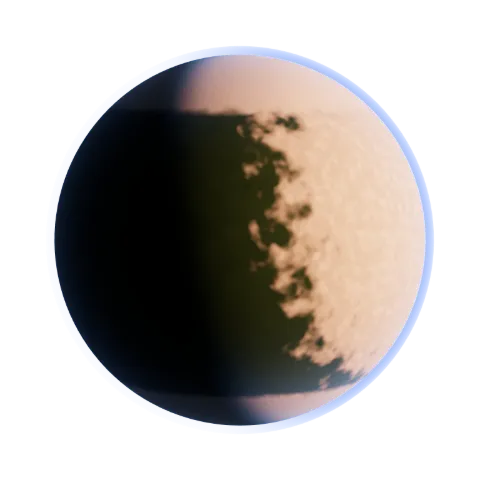
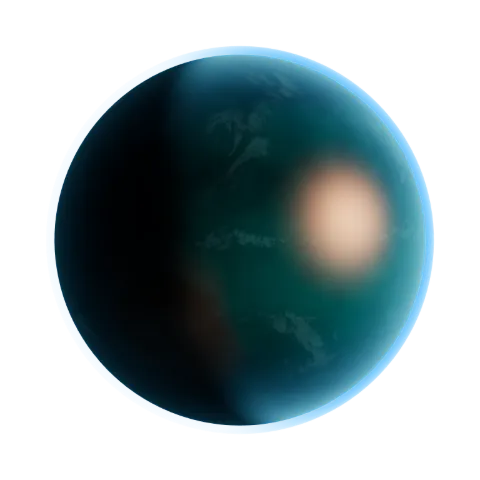
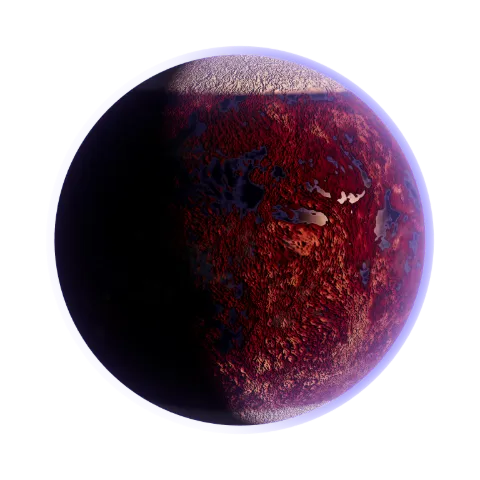
All planetsEarth-like ExoplanetsOcean CandidateTRAPPIST-1 e · Rocky planet, habitable zoneRadius0.92 × EarthTemperature251 K (-22 °C) Earth-like ExoplanetsFrozen-Sea WorldTRAPPIST-1 f · Rocky planet, habitable zoneRadius1.05 × EarthTemperature219 K (-54 °C) Earth-like ExoplanetsOuter Ice WorldTRAPPIST-1 g · Rocky planet, outer habitable zoneRadius1.13 × EarthTemperature198 K (-75 °C) Earth-like ExoplanetsEyeball Ocean WorldLHS 1140 b · Water world candidateRadius1.73 × EarthTemperature226 K (-47 °C) Earth-like ExoplanetsTESS’s EarthTOI-700 d · Rocky planet, habitable zoneRadius1.07 × EarthTemperature269 K (-4 °C) Earth-like ExoplanetsHycean WorldK2-18 b · Sub-Neptune, habitable zoneRadius2.61 × EarthTemperature255 K (-18 °C) Earth-like ExoplanetsThe Missed TwinKepler-1649 c · Earth-sized planetRadius1.06 × EarthTemperature234 K (-39 °C) Earth-like ExoplanetsEarth’s CousinKepler-186 f · Rocky planet, habitable zoneRadius1.17 × EarthTemperature188 K (-85 °C)