Earth-like Exoplanets
Eyeball Ocean World
LHS 1140 b · Water world candidate
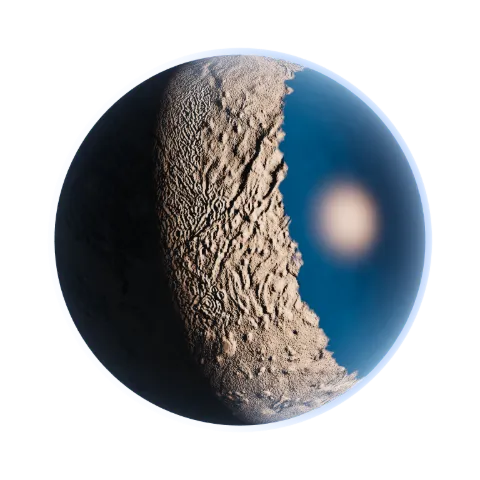
A possible frozen “eyeball” world in its star’s habitable zone. JWST ruled out a thick hydrogen envelope; if it has an Earth-like nitrogen atmosphere, models predict an ice shell with a liquid ocean about 4,000 km wide always facing its star.
- Radius
- 1.73 × Earth
- Temperature
- 226 K (-47 °C)
- From Earth
- 48.9 light‑years
- Eyeball
- Frozen all over, except an ocean always facing its star
- The ocean
- About 4,000 km across, if the models are right
- Sun
- A quiet red dwarf, almost straight overhead, forever
- Size
- 1.7 × Earth’s width
- One year
- 25 days
You stand on the ice near the shore of the sunlit ocean. Whether it has the air this needs is still uncertain; JWST has ruled out a thick hydrogen one.
Eyeball Ocean World at a glance
- Status
- Confirmed planet
- Radius
- 1.73 × Earth
- Mass
- 5.6 × Earth
- Year length
- 24.7 days
- Temperature
- 226 K (-47 °C)
- Host star
- LHS 1140 (M4.5 V red dwarf)
- From Earth
- 48.9 light-years
- Discovered
- 2017 · Transit
- Data
- NASA Exoplanet Archive
Facts
- Arguably one of the most disturbing “eyeball” planets: a rocky world larger than Earth, almost completely frozen solid.
- One side always faces its quiet red star; the other faces the rest of space and is a massive shield of ice.
- Right at the centre of the star-facing side, where the heat is strongest, the ice melts into a giant ocean, by some models about 4,000 km across.
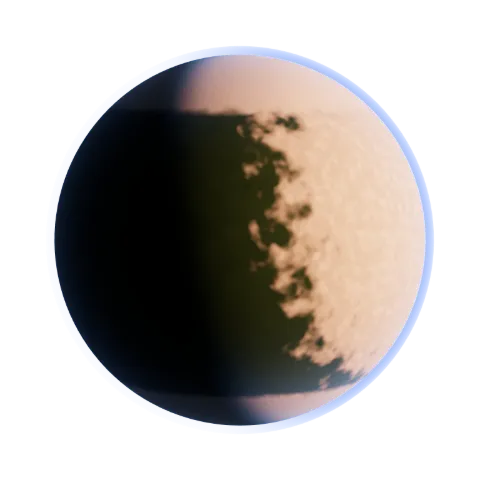
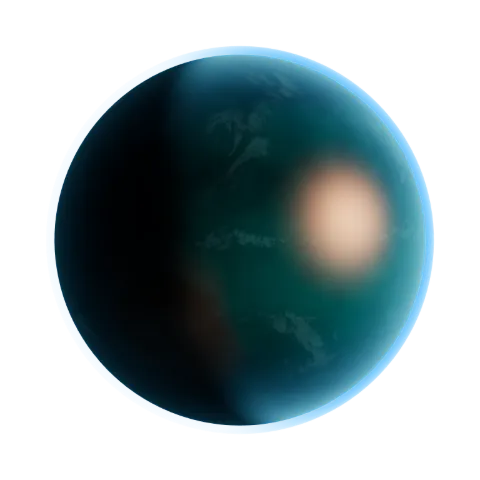
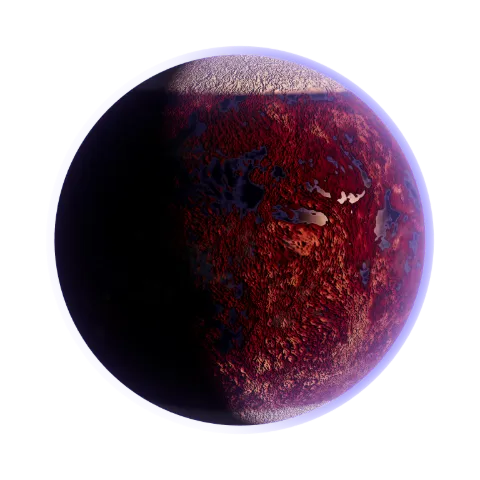
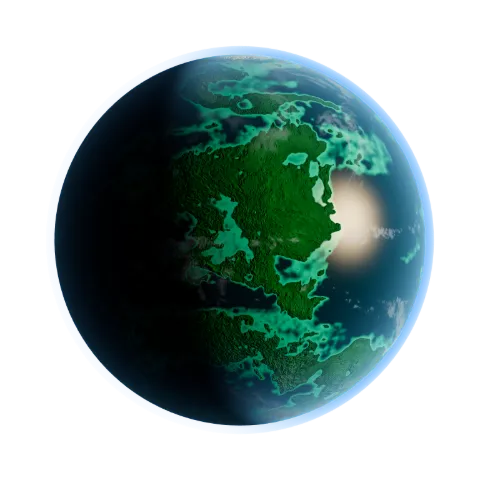
- From space it would look like a giant eye staring at its sun without blinking: the dark ocean the pupil, the frozen wasteland the white.
History and research
Jason Dittmann’s team found it in 2017 with MEarth-South, a set of small robotic telescopes in Chile, and weighed it with the HARPS spectrograph. Its star is a red dwarf about 49 light-years away in Cetus. A second, smaller planet closer in was found in 2019.
It is one of the few habitable-zone planets that both crosses its star and is close enough for Webb. In 2024 Charles Cadieux’s team used Webb to rule out a thick, puffy hydrogen envelope.
Sources: Wikipedia: LHS 1140 b. Checked 27 October 2026.
How big is Eyeball Ocean World?
Eyeball Ocean World is 22,044 km across: 1.73 times as wide as Earth.
Questions about Eyeball Ocean World
How far away is LHS 1140 b?
48.9 light-years from Earth. Even at the speed of light, the trip would take 48.9 years.
How big is LHS 1140 b?
Its radius is 1.73 times Earth’s, about 1.7 times as wide as Earth.
How long is a year on LHS 1140 b?
It goes once round its star in 24.7 days. How old would you be there? →
How hot is LHS 1140 b?
About 226 K (-47 °C).
What would I weigh on LHS 1140 b?
Gravity at the surface is 18.4 m/s², 1.87 times Earth’s. Scales that read 50 kg on Earth would read about 93.6 kg on LHS 1140 b. Work out your own weight there →
When was LHS 1140 b discovered?
In 2017, by the transit method: the slight dip in its star’s light each time the planet passes in front of it.
More Exoplanets
All planetsEarth-like ExoplanetsTESS’s EarthTOI-700 d · Rocky planet, habitable zoneRadius1.07 × EarthTemperature269 K (-4 °C) Earth-like ExoplanetsHycean WorldK2-18 b · Sub-Neptune, habitable zoneRadius2.61 × EarthTemperature255 K (-18 °C) Earth-like ExoplanetsThe Missed TwinKepler-1649 c · Earth-sized planetRadius1.06 × EarthTemperature234 K (-39 °C) Earth-like ExoplanetsEarth’s CousinKepler-186 f · Rocky planet, habitable zoneRadius1.17 × EarthTemperature188 K (-85 °C) Earth-like ExoplanetsSuper-Earth HavenKepler-442 b · Super-Earth, habitable zoneRadius1.34 × EarthTemperature233 K (-40 °C) Earth-like ExoplanetsEarth 2.0Kepler-452 b · Super-Earth, habitable zoneRadius1.63 × EarthTemperature265 K (-8 °C) Hot PlanetsSurvivor PlanetKOI-55 b · Scorched planet candidateRadius0.759 × EarthTemperature7,778 K (7,505 °C) Hot PlanetsHottest PlanetKELT-9b · Ultra-hot JupiterRadius1.94 × JupiterTemperature3,921 K (3,648 °C)